Jakub SLOWIK Interview
Q, before talking about joining Tokyo, please tell us about your time in Sendai, where you played for 2 and a half years after coming to Japan for the first time.
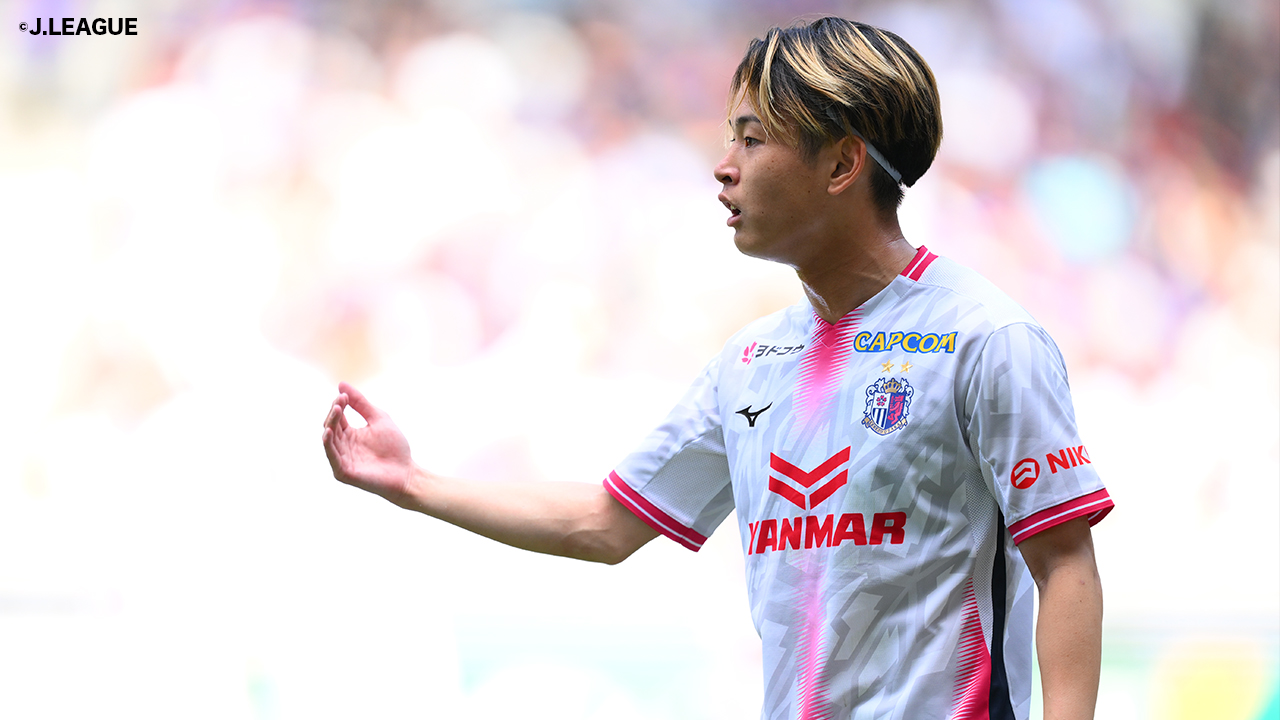
A, For me and my family, living in Sendai was a very happy experience. We received a lot of support from the fans and supporters in Sendai. I have only good memories. I am grateful to the club staff, and I still remember the debut match against Cerezo Osaka. Of course, there were also matches against Tokyo, and I have only happy memories.
Q, the press release from Sendai included the loving words "Let's meet again in J1 for sure." Player Kubo (nickname for Słowik) will continue to fight on the J1 stage as a member of Tokyo from here.
A, I am of course disappointed with the result of Sendai's relegation to J2 in the 2021 season. However, I approached everything from practice to games with full effort. In the midst of that, I was very happy to receive an offer from Tokyo, a big club in Japan, and I want to win many things with my teammates at this club.
Q, what was your impression of Tokyo as an opponent?
A, In the 2019 season, when I first came to Japan, Tokyo was competing for the championship. My impression is that they were a strong team at the very top of the standings. They are also a team whose players always perform well with quality in matches.
Q, in the 2021 season, Tokyo won twice against Sendai, and in both matches, Kubo’s big saves stood out.
A, I remember (laughs). But in the end, Sendai was defeated. We did our best, but Tokyo has many high-quality players, so that was the result.
Q, which Tokyo player has left the strongest impression on you?
A, Diego OLIVEIRA. I faced him twice in penalty shootouts, so he left a strong impression on me (laughs). His penalty kick style is unique, and I think he is truly a skilled player. From a goalkeeper’s perspective, his style is difficult to deal with, but now that we are on the same team, I feel that if he takes penalty kicks in practice, I’ll be able to handle any style (laughs).
Q, Tokyo has excellent GKs, but what is your impression of the level of Japanese GKs?
A, Of course, Tokyo has talented GKs, and Kosei TANI from Shonan is also a wonderful talent. Keisuke OSAKO from Hiroshima and Yuma OBATA, who also played for Sendai, are the same. I get the impression that there are more and more promising players full of potential. There is no doubt that the quality of Japanese GKs is improving.
Q, Player Kubo's home country, Poland, has produced many renowned goalkeepers such as Jerzy Dudek and Wojciech Szczęsny. Krzysztof Kamiński, who previously played for Iwata, has also been active.
A, That is very important for Polish football. Many goalkeepers have played for major European clubs and continue to do so. Besides the players mentioned, goalkeepers like Artur Boruc (who played alongside Shunsuke Nakamura at Celtic and Maya Yoshida at Southampton) and Łukasz Fabiański are also outstanding. In Japan, Kamiński's remarkable achievements paved the way for me to come here. I want to fully demonstrate the strength of Polish goalkeepers here at Tokyo as well.
Q. By the way, at what age did Kuba start playing as a GK?
A. That was quite a long time ago... (laughs) I think it was around when I was 5 or 6 years old. My older brother started playing soccer first, and since I was the youngest, I ended up becoming the GK. Everyone disliked being GK because you have to fall down and sometimes drop from high places when making saves, but for me, that was normal and didn’t bother me. After that, I also had experience playing as a defender. I belonged to a large academy, but since my playing style wasn’t very technical (laughs), the coach suggested, “How about trying GK?” Receiving the GK gloves was also a motivation for me, and from then on, I have been dedicated solely to being a GK.
Q. Since there are many famous goalkeepers, I thought it was a popular position in Poland.
A. I think children in every country initially want to be strikers (laughs). When players like Dudek and Boruc were active, goalkeepers also became popular, but after all, when it comes to Poland, it’s Robert Lewandowski. So, I think many players admire forwards.
Q. Looking at your career, you have played for domestic clubs in Poland, but I have read news that in 2015 you came close to signing with Reading in England.
A. At that time, I went for a trial that lasted about a week. However, the team's goalkeeper slots were already filled, and shortly after, I also got injured, so things didn’t progress as I had hoped. But I had always wanted to test my potential and abilities overseas someday, and that first opportunity ended up being in Japan. I have held that desire since my time in Poland.
Q. Having played in the J League for two and a half years, do you have a different impression of Japanese soccer now compared to when you first arrived?
A. In my opinion, Japan is a wonderful country and the league is excellent. I don’t know much about other Asian countries, but I think it is a fantastic league.
Q. For the 2022 season, Albert PUIG ORTONEDA will take charge of Tokyo. He led Albirex Niigata until the 2021 season. Have you had a chance to watch Albert’s team play?
A. I have watched a few matches from his time at Niigata. I checked them to understand what kind of football they play and what kind of performance is expected. My impression is that it’s a style focused on ball possession, and I think building attacks from the GK and defenders will also be required. Originally, the GK’s role was to firmly protect the goal and stop shots, but nowadays the demands are much broader. This includes footwork skills and kicking. Probably, Tokyo’s new style will require many of these aspects. My approach is to fully absorb, learn, and improve on what is demanded from practice onward. I want to tackle this with a positive attitude so I can adapt properly.
Q. In 2021, Tokyo’s challenge was conceding too many goals. Fans and supporters probably expect Kubá to make the most saves, but how do you want to improve the defense including the defenders?
A. No team can protect the goal alone, nor can a single player score all the goals. Everyone from the forwards to the goalkeeper must attack and defend together. In my case, I want to communicate more with the defenders and specifically maintain a compact formation so that we can defend effectively.
Q. Do you have a clear goal you want to achieve with this team?
A. I don’t usually set personal goals, but first and foremost, I want the team to head in a positive direction and produce results. It would be great to win more trophies, but above all, I want us to fight hard and become a group that fans and supporters can be proud of, saying, "This is truly a great team." The players must continue to perform in a way that inspires such words from many people.
Q. Lastly, what are you looking forward to about living in Tokyo, the capital of Japan?
A. Tokyo is truly a major metropolis and I have the impression that it is a wonderful city on a global scale. My family is also looking forward to it, but what’s important is that we can always be together no matter where we are. One thing I’m excited about is that Disneyland will be closer than from Sendai (laughs). I’m also looking forward to other famous spots. I love Japanese food as well; sushi and yakiniku are the best. Natto? When I first tried it, it was no good, but gradually I’m getting used to it (laughs).
text by YUKI NISHIKAWA