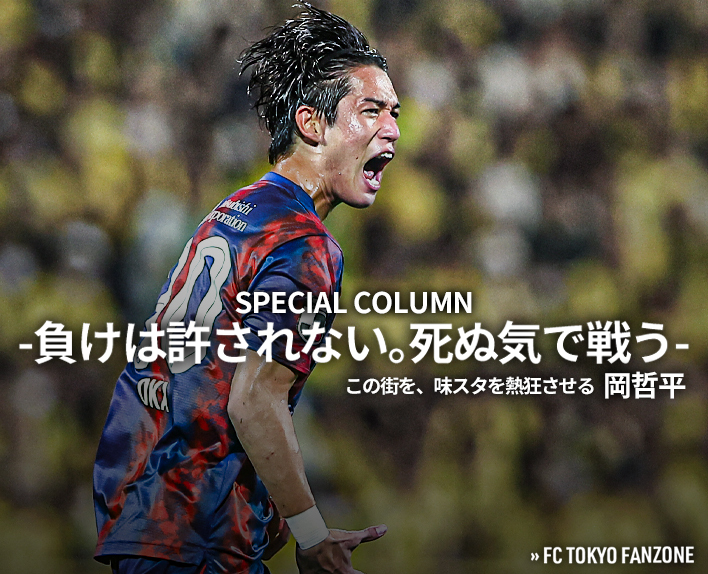


It has long been seen that universities are solving the post-youth development issue, and this season in Tokyo, there has been increasing evidence to support that view. It is the presence of Teppei OKA, who, despite having just graduated from Meiji University, is already making an impact as an immediate asset.
Tokyo's academy produces many talented players. However, the top team cannot absorb them all, so after graduation, they seek opportunities in university soccer clubs across the country. They gain experience at university and aim to become professionals in various categories or, in some cases, overseas.
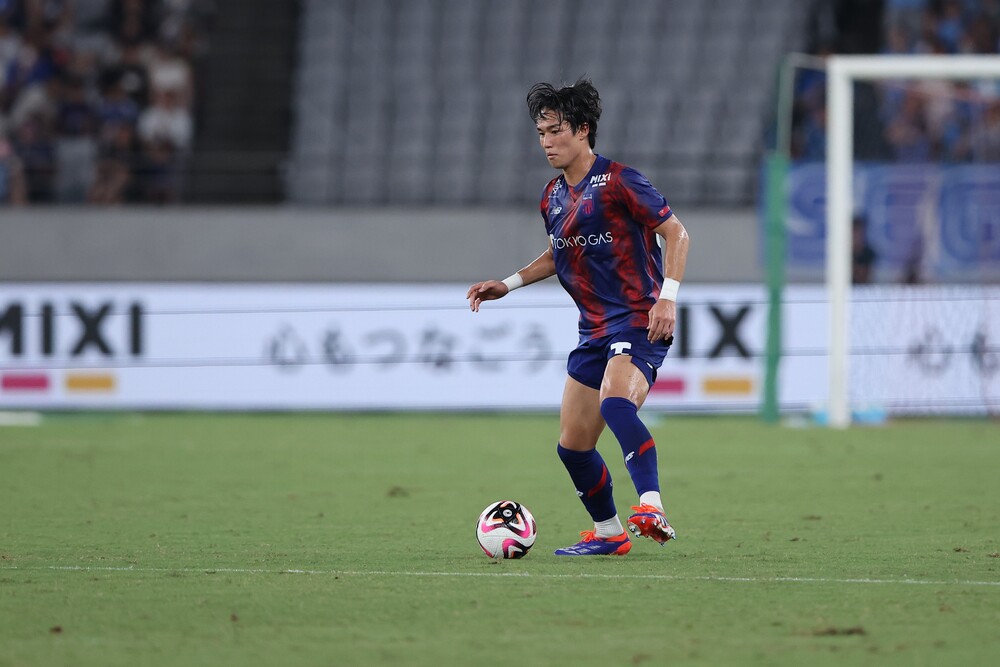
As a result, cases of "returning" to Tokyo's top team via university have been increasing. This includes players like Shuto ABE (currently at RWD Molenbeek) and Kouta TOKIWA (scheduled to join in the 2025 season), but there are also examples like Hotaka NAKAMURA, who, although not from Tokyo's academy, was trained at Meiji University and is active as a member of the Blue-Red Army, showing the strong trust in the university's soccer club. Furthermore, Oka is beginning to realize in reality his own words spoken at the announcement of the new system: "I really want to prove that going to university is not a detour. I want to be used as an immediate asset."
Securing his field of vision, he delivers precise passes into the open space ahead. Whether in aerial duels or ground battles, he uses his body to win contests both offensively and defensively. These aspects of his play were already fairly well developed during his university days, and such characteristics have become more pronounced as time has passed since his debut with Tokyo and his nerves have eased. Playing freely, powerfully, and decisively, he has established himself as a starting center back. While changing the partner beside him, he is exploring improvements as a team. In Sec. 22 against Kashiwa Reysol, at the memorable SANKYO FRONTIER Kashiwa Stadium where his senior Tsuyoshi WATANABE also scored, he shocked everyone by scoring his first J1 League goal, demonstrating his strong attacking ability.
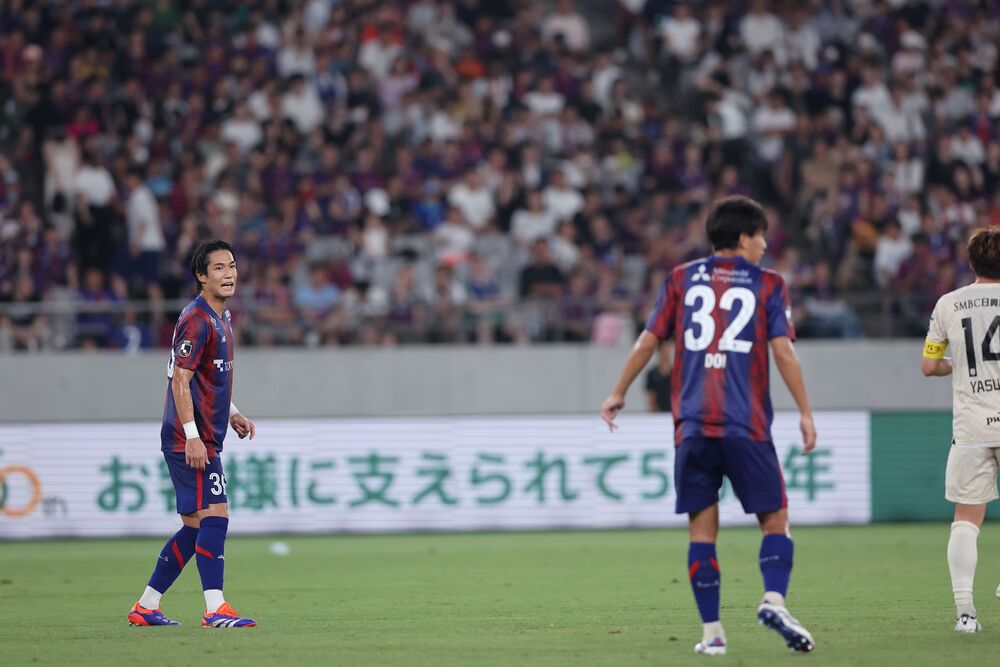
Recently, a partnership with Kanta DOI was realized. Kanta DOI, who was promoted directly from FC Tokyo U-18 to the top team, is in his second year after graduating high school. In the match against Kyoto Sanga F.C. on May 3, in Sec. 11, Kanta DOI started as a member of the starting lineup, and when he left the game in the first half due to injury, there was a "strange connection" as player Oka made his J1 League debut by coming on from the kickoff in the second half. The result of achieving the first victory of the season at Ajinomoto Stadium through the interchange of academy players seemed to symbolize the future, and that future has already taken a concrete form.
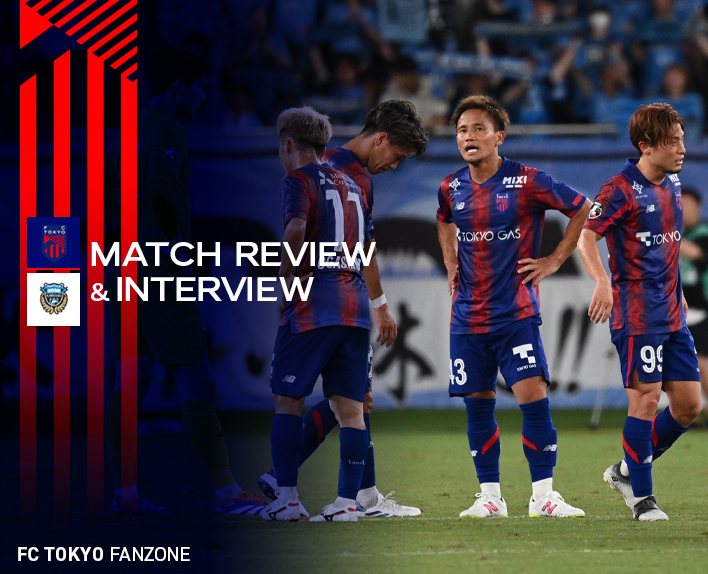
After the break, the first match resumed, Sec. 25 against Gamba Osaka ended in a 0-0 draw. The combination of players Oka and Dohi had a good start, but stumbled in the second match. In Sec. 26 against Kawasaki Frontale, they lost with 3 goals conceded. In both cases, the defense was not broken down; the goals conceded were from crosses and set plays that were matched at points.
"I think the cause of the goals conceded was the lax pressure on the ball holder and the failure of the center backs, including myself, to mark properly. We were simply beaten by Shin YAMADA. I believe the responsibility for the goals conceded lies with Kanta and me."
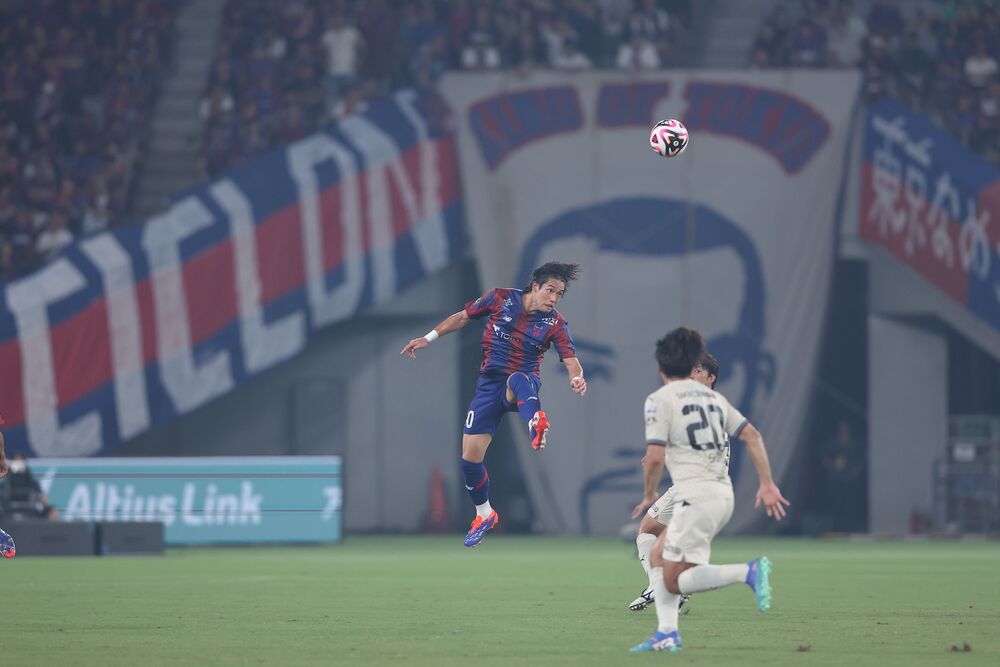
In the early stages, Tokyo created several chances with side attacks. However, after failing to score, Kawasaki's player Yamada scored 2 goals in the middle of the first half with a header. This had a big impact on the game. Yamada is 175cm tall. It wasn't a matter of height, but rather losing to the opponent's positioning, timing, and accuracy. Ironically, Yamada was coached by Mitsuhiro TODA, who used to play as a forward for Tokyo. Nevertheless, it is certain that this is where their weakness was exposed.
As long as you are playing in a professional match, there is no doubt that you are an excellent player at that point. However, when you are young, you tend to 'discover' areas you are not good at during actual matches. By overcoming these challenges one by one, you can enhance your own abilities. Even for the veteran Masato MORISHIGE, after the 2010 season, where he had three suspensions, he focused on more reliable defense from the following season and climbed to participate in the World Cup as a member of the Japan national team. In that sense, the upcoming match against Tokyo Verdy after this defeat will be a crucial moment for Oka.
We organized a structured defense, responding from a set position in the middle zone. Depending on the situation, we apply pressure from the front and are also challenging ourselves to initiate attacks. However, our closing down on the opponent’s key crosser was weak, and we also allowed the finisher to remain free inside. To avoid conceding multiple goals like in the Tamagawa Clasico, it will be important to improve our response to crosses.
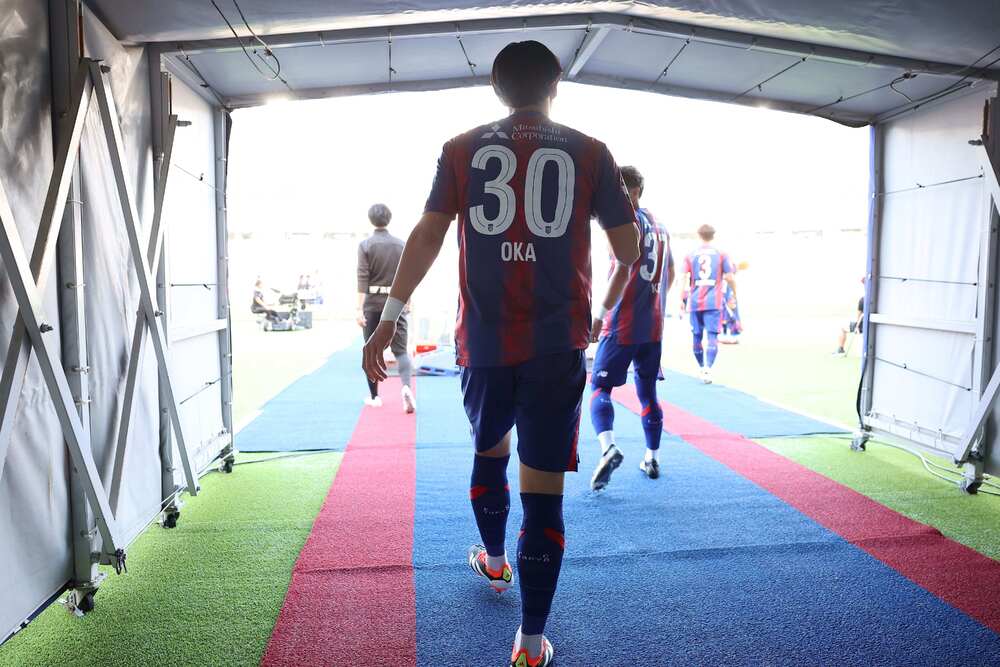
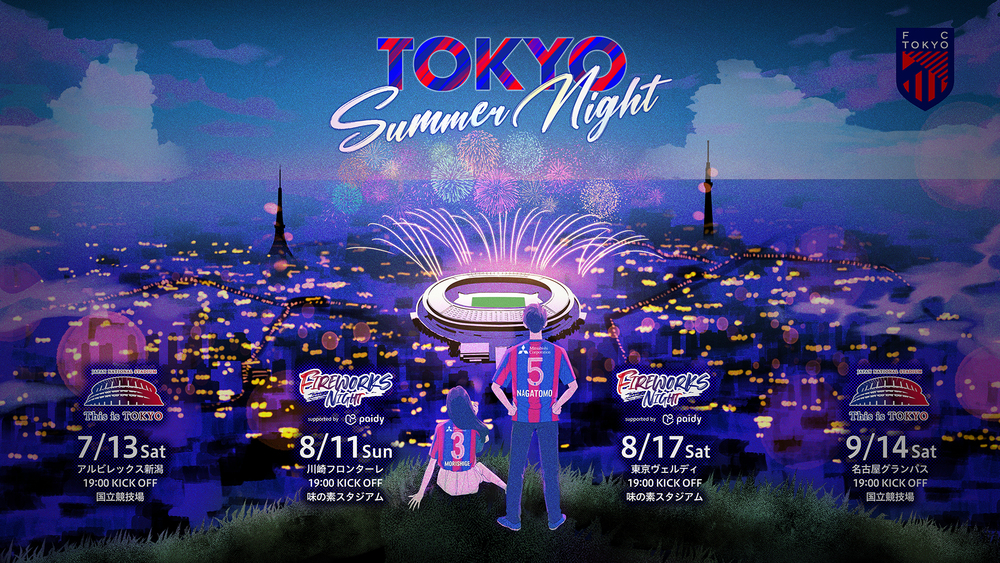
And, more than the Tama River Clasico, on August 17th, there is a strong need to win at home at Ajinomoto Stadium, and we cannot afford to lose.
"If the team’s feelings are not united as one, I wonder if we simply can’t work backward from victory. Next, we need to switch gears and truly come together as one team for the match against Tokyo Verdy, aligning our spirits. Running for the team, putting our bodies on the line to defend, throwing ourselves to protect the goal—these were all generally lacking. For the fans and supporters who are pushing us forward, I want to spare no effort and align our vectors. Since I have never been allowed to lose to rival teams since I was a child, I will put my body on the line with all my might and first and foremost protect the goal."
Having grown up in blue and red, I cannot afford to lose to green. At home in Ajinomoto Stadium, where victories have been scarce this season, a young warrior from the academy shows a resolve to fight to the death.
text by Katsu Goto (Freelance Writer)