

Q. First of all, welcome back.
A. I'm back. Thank you very much.
Q. Was the atmosphere different from the age-group national teams, not only in matches but also in training with the Japan national team?
A. That's right. In the age-group national teams, it's a gathering of players of the same age, but this time there were players from various age groups. Each one of them is a top player playing in the world's top leagues. The tension was on a completely different level and was intense.
Q. How was the tension during the match at the Japan National Stadium?
A. I was ready to play at any time. When the match actually started and I was warming up in the second half, honestly, I was quite nervous wondering if I would be called on and what I would do if I was.
Q, You started in the match against Colombia, but did you have a feeling during the training after the Uruguay match that you would get to play?
A, during training, I also had a feeling that there was a chance for the side back position. I was prepared for the Uruguay match as well, but when I didn't play, I switched my mindset and prepared myself thinking that I might play in the next match against Colombia.
Q, how was it to actually play in the match?
A. To be honest, I don't think I was able to show my best. In defense, the first goal was conceded from my side. Honestly, the evaluation of my performance isn’t very good. Even so, the coordination on the flank with Kaoru Mitoma, which we had been discussing continuously since two days before the match, led to some successful moments. However, not being able to turn those into results remains a challenge.
Q, Did you feel that you were able to demonstrate the positioning and other skills you developed at Tokyo throughout the match?
A, It was a style of soccer similar to Tokyo's. The fullbacks would move inside, and the play involved breaking down the defense through the relationship between the wingers and fullbacks. I was intuitively accustomed to that, so I think I was able to enter the match more smoothly than other players.
Q, you were also the kicker for set pieces.
A, I knew from the practice sessions the day before and two days before that I might be the kicker. I hadn’t been able to deliver good balls in the last few matches at Tokyo. Although I only took one kick, I relaxed my shoulders and was able to kick exactly where I aimed, which gave me confidence. I want to be able to perform like that at Tokyo as well.
Q: Were you nervous during the match against Colombia?
A, I was extremely nervous. I was so tense during the warm-up that it felt like I was losing every ball in the passing drills, but that’s when I was able to clear my mind. Even in Tokyo, when my warm-up wasn’t going well, I had a sense that I could relax and get into the game smoothly once it started. I kept telling myself that even if I made mistakes during the warm-up, I could still enter the match in a good state.
Q: Weren't you nervous during the match?
A, I was somewhat calm, but when I entered the field and sang the national anthem, I truly felt that I was standing on the pitch as a member of the Japan national team. Rather than feeling nervous, my excitement rose.
Q: You took on the number 5, worn by a great senior player.
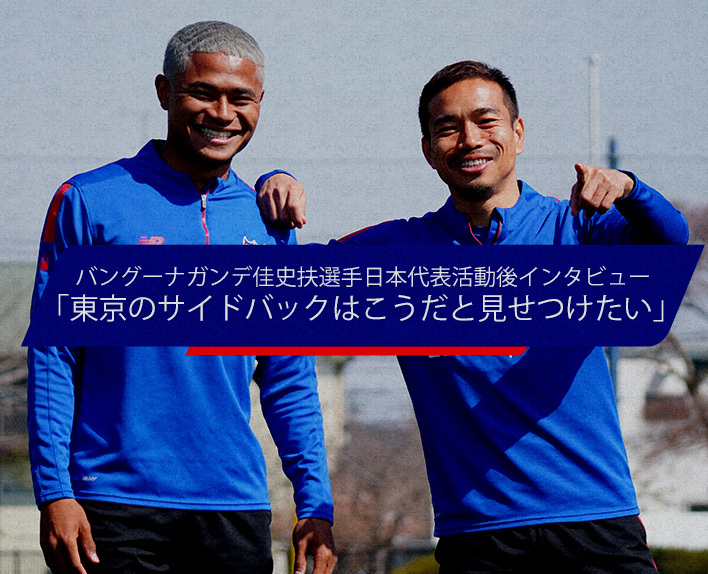
A: I also found out by looking at FC Tokyo’s Instagram and Twitter posts after practice ended at the same time as everyone else. I was really surprised. It is truly an honor to wear the number that Nagatomo has carried for 15 years. However, I still feel that I haven’t reached the same level yet, so I don’t know if I will continue to wear number 5 from now on, but I will keep giving my all and show what Tokyo’s fullback is all about.
Q: Have you talked to Nagatomo since he came back?
A: "He told me, 'I carried this number for 15 years, so you need to play with that same level of determination.' This time it's number 5, and I don't know what will happen when I'm selected in the future, but for me, the image of number 5 is strongly associated with Nagatomo. That won't change."
◇Kashif BANGNAGANDE Player Profile