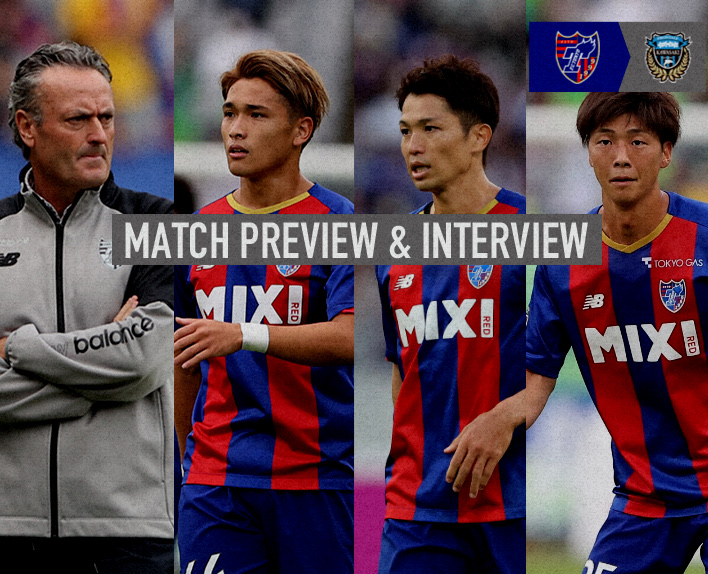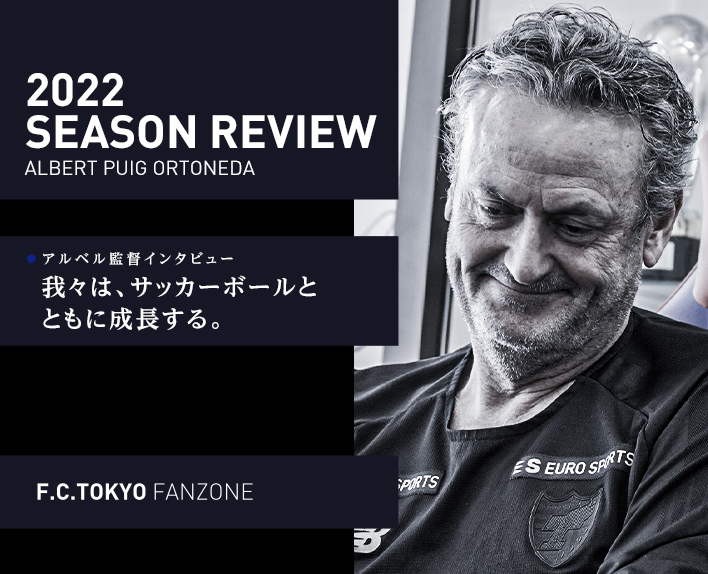


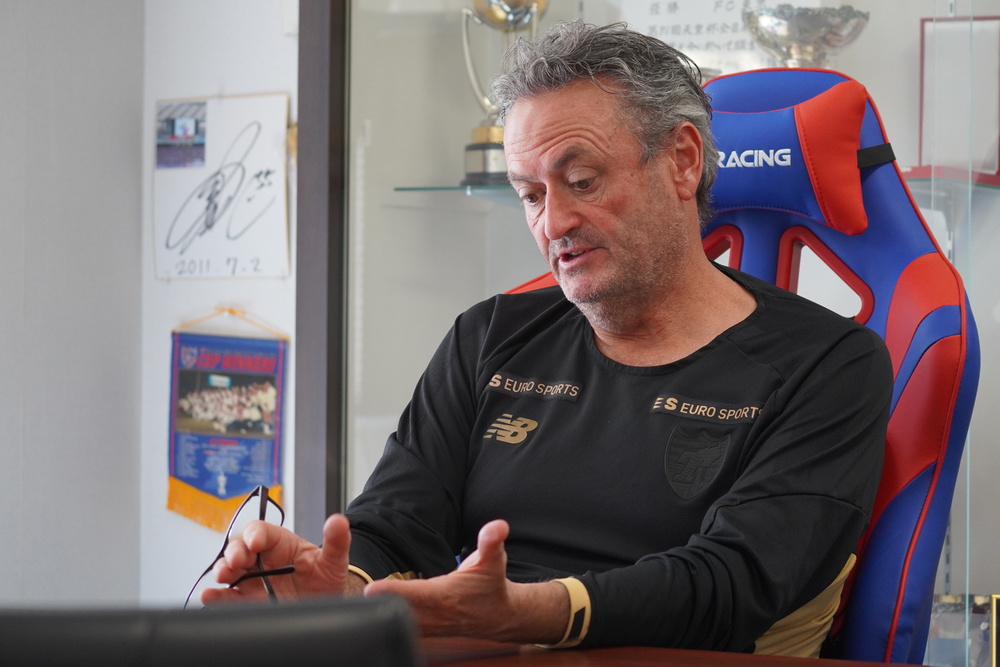
Only the final round remains for the 2022 season. How far has the penetration and construction of the new playing style progressed? And what kind of growth do they envision for Tokyo's future? With sports writer Atsushi Iio as the interviewer, we asked coach Albert Puig Ortoneda to review this season.
Q, the first season of adventure in Tokyo is about to end. What kind of response and feeling do you have before the final match, currently in 6th place in the league?
A, the major theme was to revive the team, and my task was to instill a clearly different style from before. I believed that the change had to be made with as little struggle as possible. This is because if we sought drastic changes from the start of the season and failed to earn points, the players could fall into a nervous state. Therefore, I aimed for gradual changes. Thanks to the players' high abilities and their dedicated efforts, and the warm support from fans and supporters who understood that this process was not easy, I believe we were able to implement the changes more smoothly than expected.
Q, Kashima Antlers, Sanfrecce Hiroshima, and Cerezo Osaka achieved a season double against the top teams, showing their strength and competitiveness. However, they also had some instability, losing to lower-ranked teams such as Shonan Bellmare and Vissel Kobe.
A, it is true that we were able to fight proudly in the matches against Kashima, Hiroshima, and C Osaka. However, I believe we should not take a simplistic view that we played well against top teams but struggled against lower-ranked teams. Kobe recently achieved five consecutive wins. Shonan achieved a season double against Kawasaki Frontale. Focusing on specific parts can cause us to overlook other aspects. For example, Sagan Tosu’s club size is by no means large, yet they delivered an excellent performance this season, didn’t they? The league-leading Yokohama F.Marinos suffered consecutive defeats against Gamba Osaka and Júbilo Iwata, who are fighting to avoid relegation. The J1 League is an exceptionally competitive league, unlike any other in the world. Since we are a developing team, it is natural that there are unstable parts. Even so, looking at the season as a whole, I think we grew steadily and were able to compete consistently.
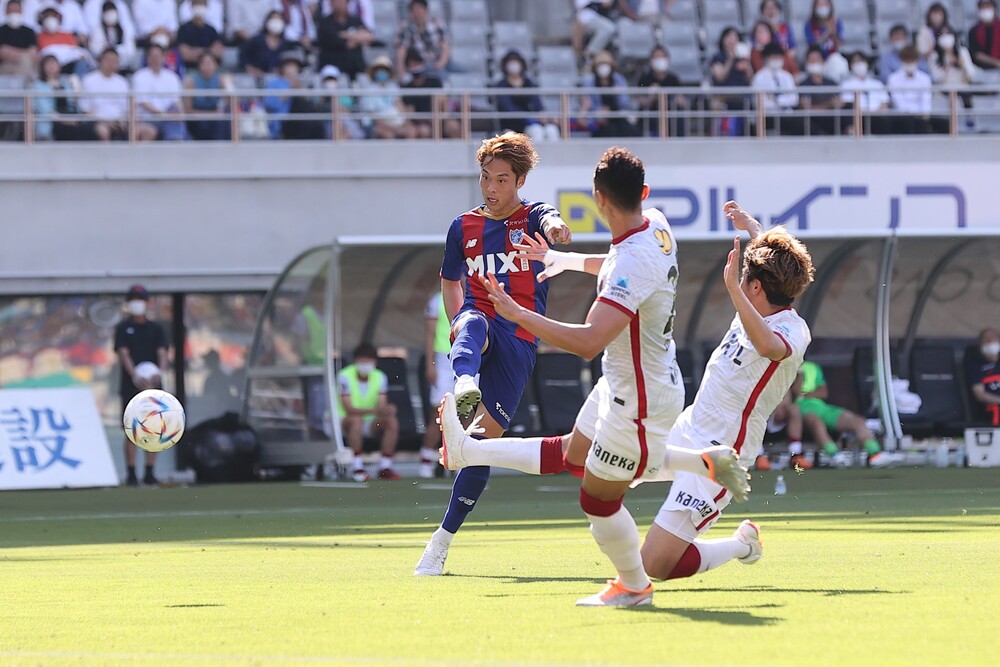
Q, certainly we only suffered two consecutive defeats in the 2nd round.
A, as I have mentioned before, I am a realist. I am the type who keeps moving forward aiming for what can realistically be achieved. When I previously led Albirex Niigata, there were many pessimists, so I had to be an optimist, but here, after just a few wins, idealists appear saying, "We might be able to win the AFC Champions League" (laughs). Perhaps the personalities differ between people from regional cities and those from the capital. However, I repeat, I am a realist. This club has not yet reached a position where it can win many titles. That is precisely why I believe we should focus on steady effort and building a solid foundation. I have been calling for "let's journey together," but for that, we must first know where we are and where we want to go. Our management scale is by no means at the top in J1, and our highest league finish in the past has been 2nd place. Understanding this reality will clarify where we must aim and fight.
Q, considering that it is a competitive league and that we attempted a style change, there was a risk of sliding down after the heavy losses against Avispa Fukuoka (Sec. 11 on May 3rd) and Tosu (Sec. 18 on June 26th). What do you think were the factors that allowed us to hold our ground and move forward again?
A, I believe the unity among the players was significant. The attitude of the leaders who took on the role of bringing the team together was remarkable. Experienced players like Morige (Masato MORISHIGE), Yuto NAGATOMO, and Keigo HIGASHI not only united the team but also adapted to the new style and delivered strong performances. Although he is no longer with us, we must also appreciate the leadership of Yojiro TAKAHAGI. When the team faced difficult situations, their ability to rally the team and offer positive encouragement was invaluable. The dedication of the foreign players to the team is also noteworthy. The growth of the younger players became a tailwind for us. Kuryu MATSUKI joined the team at 18 years old and has grown into a key player. The presence of the three players acquired in the summer (Luiz PHELLYPE, Koki TSUKAGAWA, and Seiji KIMURA) was also significant. I believe that the intertwining of all these factors is why we avoided falling into a relegation battle.
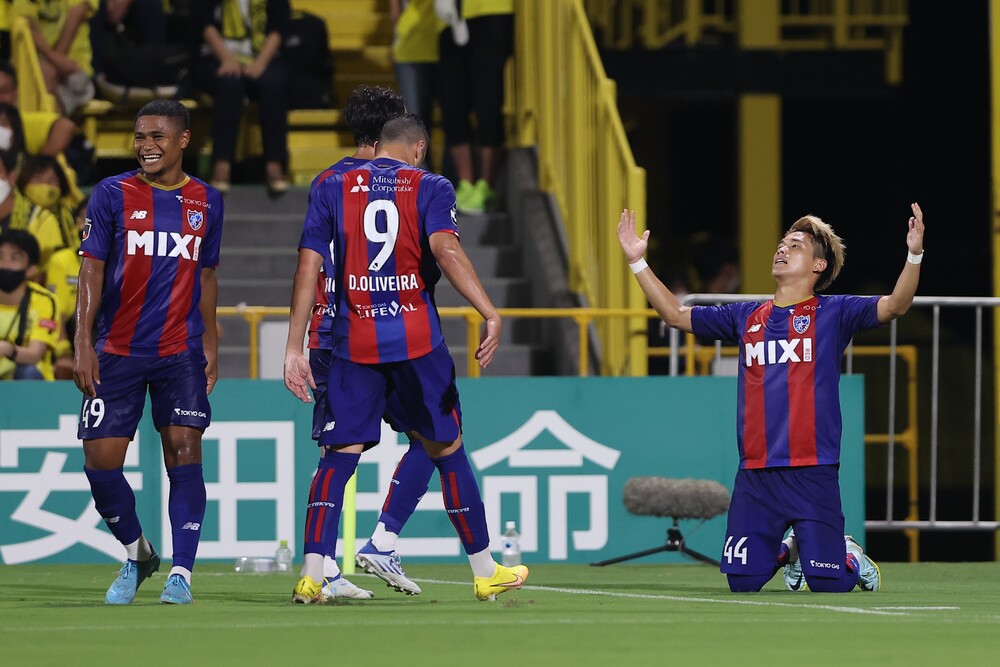
Q, before the opening, I couldn't imagine that young players like Kuryu MATSUKI and Kashif BANGNAGANDE, as well as the veteran Ryoma WATANABE, would perform so well.
A, it's not just them. Hotaka NAKAMURA has also achieved remarkable growth. Shuto ABE and Kazuya KONNO have both developed significantly. Seiji KIMURA has also grown a lot. I believe the young players in their growth phase and the experienced veterans have blended well and guided the team in a positive direction.
Q, I think it was also significant that Tsukagawa, who was acquired in the middle of the season, fit smoothly into the team. I remember being impressed by the fact that after his acquisition, it was said that "Tsukagawa's playing style has changed from before."
A, When I was leading Niigata, I watched his play in Matsumoto. After that, Tsukagawa spent a year and a half at Kawasaki, during which his playing style clearly changed, transforming him into a player who fits our team. It is common for a team's style to foster player growth. The players who played under me at Niigata also changed their preferred playing styles. For example, Akito FUKUTA, who now plays at Tosu, learned to value ball possession at Niigata, and now contributes not only defensively but also offensively. I believe the same thing is happening in Tokyo. I heard that Yuto was viewed with skepticism last season. However, I doubt there is anyone criticizing his performance this season. Moreover, he is playing on the right side, not his usual left side. Furthermore, although he is a side back, he plays in the center of the pitch like a midfielder. He proves that growth is encouraged by one’s attitude toward effort, regardless of age. Keigo is the same, isn’t he? After all, soccer players grow together with the soccer ball. I believe there is no other way. And the soccer ball cooperates with players who have a strong desire to grow.
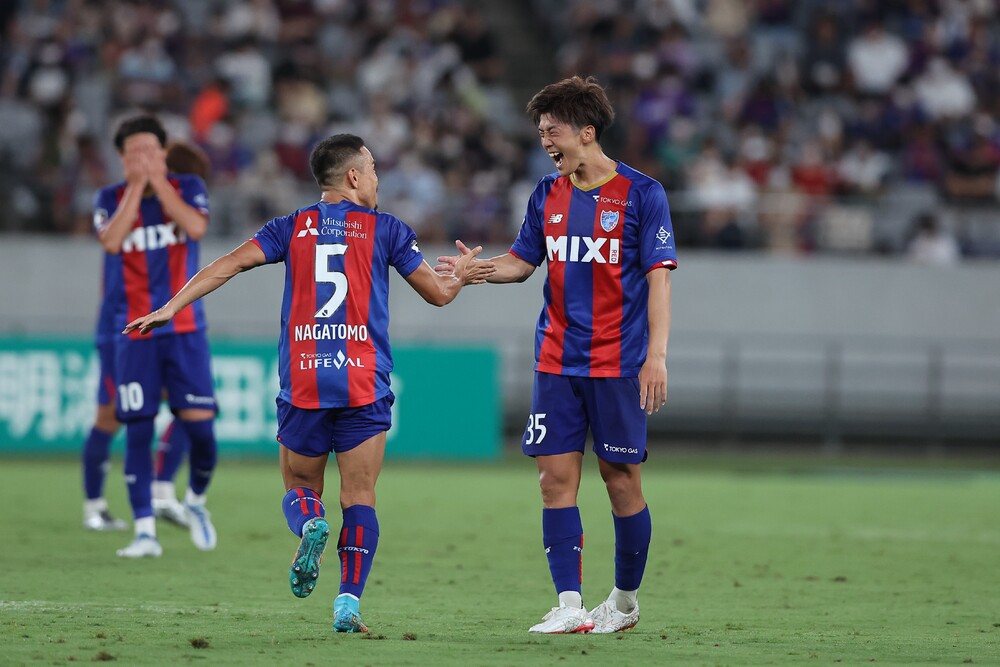
Q, it's a good word, isn't it? So, please tell us about the phase. The team that has been able to control the ball since the Shimizu S-Pulse match in the first half of the season (Sec. 15 on May 25th) and the Kashima match (Sec. 16 on May 29th) is now entering the phase of "moving towards the goal while maintaining possession of the ball". Is the timing of this transition phase going according to plan?
A, thanks to the high quality of the players and their efforts, we have been able to transition to the next phase earlier than I expected. That said, it is not as simple as winning every match or definitely securing a title next season. What is important is to build the foundation, and that foundation building is progressing well now.
Q, can we say that a solid foundation has been built in this past year regarding the base?
A, when I talk about the base, I mean whether the players understand what our style is like. For example, in cooking, it is important to understand what ingredients to use and how to prepare them. That is the base. In that regard, we have been able to build it. However, just as in cooking, when the quality of the ingredients improves, the quality of the dish also upgrades. Similarly, in a soccer team, when the quality of the players improves, the quality of the play they can express also rises. That is why Manchester City and Liverpool are always trying to acquire better players.
Q, Coach Albert Puig Ortoneda has often been asked about the importance of ball possession, and the players have gained a deeper understanding.
A, That's right. I have talked about it many times to help them understand, and I showed them videos to deepen their understanding. However, no matter how much I explain the style of soccer we aim for in words and they understand it, if we cannot accumulate points, everyone will feel anxious and start to doubt. In that sense, being able to progress through the process while accumulating points this season is a positive aspect heading into the second year.
Q, what phase will the team enter in the future?
A, it is a phase of "dominating the game in a more perfect form." However, I do not envision dominating the game with an extremely high ball possession rate. It is not just about passing the ball around. I want to aim to dominate the game by maintaining possession in an appropriate manner and winning the match. Continuously playing with the ball will boost the players' confidence. I believe that leads to growth and game control. But before that, we must first have the newly added players understand our style and adapt to the team. On the other hand, what I absolutely will not do is adopt a Japanese-style approach.
Q, what do you mean by a Japanese-style?
A, it means making grandiose claims like "We aim to win the championship" or "We will achieve the treble" (laughs).
Q, I see, is that so (wry smile).
A, what I firmly believe without doubt is that a clear idea and the accumulation of daily efforts lead to success. I do not guarantee results. For me, success is not what I am doing now, but what I leave behind. This season, Niigata achieved victory in the J2 League and secured promotion back to the J1 League. President Yukio Nakano, Director of Strengthening Yoshito Terakawa, and Coach Rikizo MATSUHASHI achieved success. After I left, it was they who brought continuity to the team. Thanks to their continued efforts, my conviction that the right ideas and sustained effort lead to success has grown stronger. I want to accomplish the same thing here in Tokyo. Niigata’s next goal will likely be to become a team that can remain in the J1 League for a long time. Meanwhile, Tokyo aims to consistently finish among the top 3 to 4 teams every year and always be involved in the championship race. I am currently challenging myself to build that foundation. This cannot be achieved by efforts on the field alone. We must acquire high-quality players almost every year and gradually expand the scale of management. It is also necessary to gradually increase the number of fans and supporters filling the stadium. It is important that everyone cooperates and makes efforts to move in the same direction.
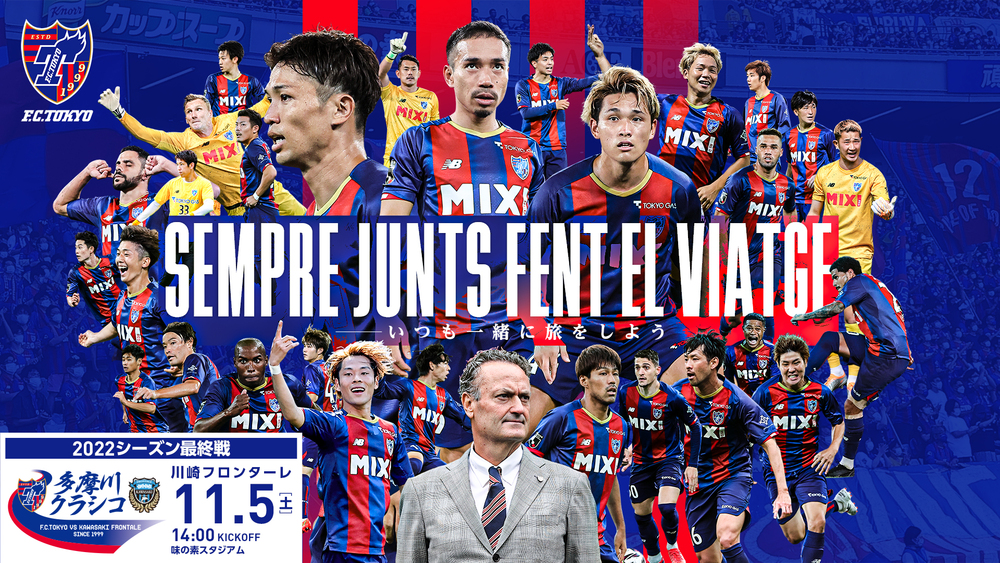
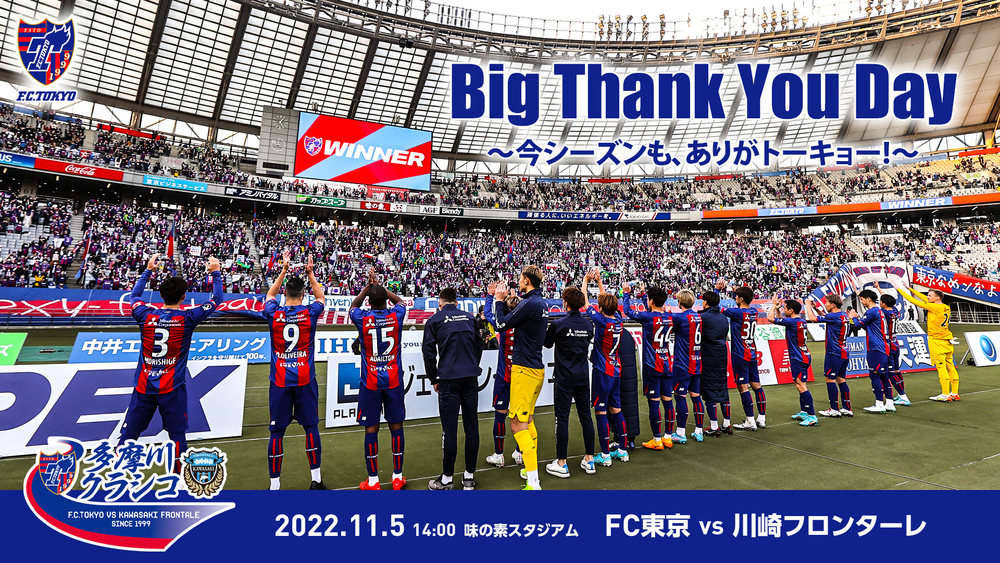
Q, this weekend will finally be the last game of the season in the Tama River Clasico against Kawasaki. Since we also played against Kawasaki in the opening match, it will be a game where we can confirm the growth of this season.
A, I am hoping it will be a wonderful match. I want both teams to play offensively and for it to be an exciting game to watch. And since it’s the final home game, it would be fantastic if we could bring great joy to our fans and supporters. However, I don’t think we should evaluate the team’s growth by comparing the performance of this match with the opening game. That’s because the quality and outcome of a match are influenced by various factors. It could be our mistakes or Kawasaki’s mistakes. Many elements affect the flow and content of the game. So, I want everyone to enjoy this last game of the season separately from the opening match.
Text by Atsushi Iio (Sports Writer)