[Albert PUIG ORTONEDA Interview]
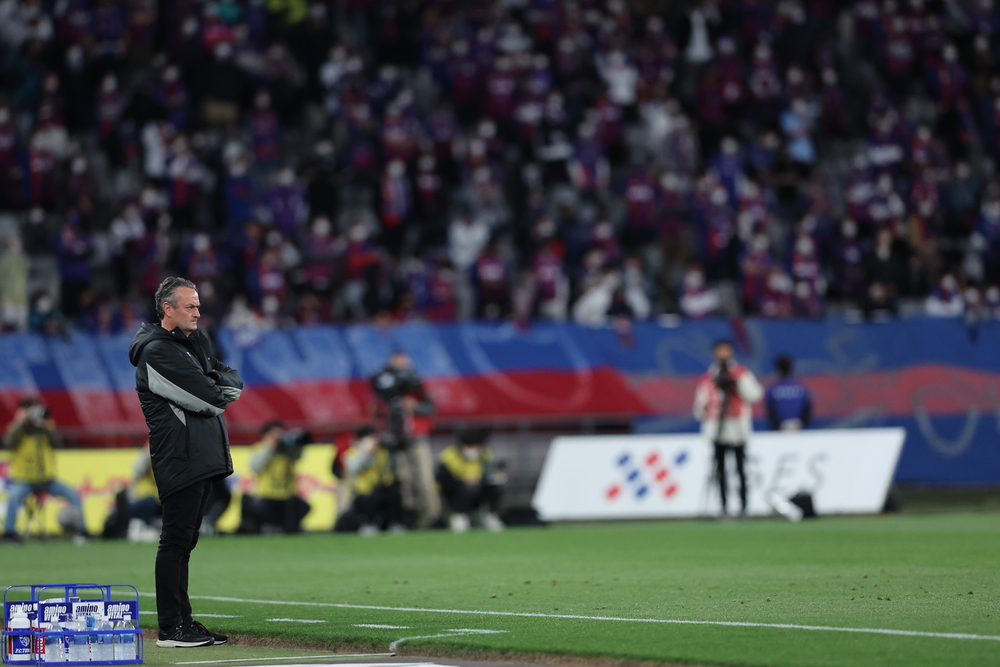
Q, speaking of last season, Tokyo was completely outplayed by Urawa in the second half of the game due to the successful implementation of Ricardo RODRIGUEZ's tactics. What are your thoughts on Coach Ricardo's style of play?
A, I think Coach Ricardo gave excellent leadership over four seasons at Tokushima. Regarding Urawa last season, I believe they played well, and their summer reinforcements also functioned effectively. Although they are struggling at the start of this season, there is no doubt that they are a difficult opponent to face. This season, Urawa is competing under a more congested schedule than us, and with the ACL starting next week, they are fighting through a tough schedule. In any case, I recognize them as one of the great clubs in J1. However, as I always say, our own play is more important than the opponent. Without being influenced by the opposing team, we want to make daily efforts to improve ourselves, and that applies equally to both practice and matches.
Q, what positive effect do you think there will be for the Urawa game by performing well in the Kobe match?
A, there were many aspects to be praised in the Kobe match. There were also several points for improvement. For example, at the start, we ceded control of the game to the opponent, and that is something we want to improve. Our attacks through the center were also weak, so we want to work on that as well. However, with each match, the team is leveling up to play more automatically and smoothly. Based on the Kobe match, we want to identify areas for improvement and use them to raise our level. Taking into account Urawa’s characteristics, we hope the team will continue to grow throughout the game.
Q: It seemed like you had a good understanding of how to approach interviews with Watanabe TSUBASA. Although there were times when you made mistakes depending on the situation, did you feel that there was a sense of progress in understanding each player's position as a whole?
A, it has only been three months since the team started. I believe it is commendable that players who had not played in the current style have grown this much. However, on the other hand, we must understand that because it has only been three months, there are daily points for correction. I am pleased that the players are positively working every day toward the team’s maturation, taking this as a natural process. They are strongly motivated to learn, and we have a group of high-quality players. Because they have a mentality focused on competing, their growth speed is faster than expected. At the same time, the wonderful atmosphere within the team also supports this progress.
In addition, it is also positive that there is a great relationship between the team and the fans and supporters. In the Kobe match, we conceded in a way that we did not expect and the game progressed in a losing state. Even in that situation, the fans and supporters in the stands calmly supported us without getting nervous, which had a positive effect on the team. The fans and supporters give confidence to the team. It is a very important boost for the team. And I think that professional sports is entertainment. The fans and supporters who come to the stadium pay for tickets to see something great. In that sense, we have an obligation to express impressive plays. However, there are wins and losses in games, and sometimes we lose, but I think it is our duty to express something impressive. In addition, I think the fans and supporters appreciated that we continued to play aggressively, seeking additional points without becoming passive, even in a situation where we were winning 3-1 in the Kobe match.
Q, please tell us what you expect from Kuryu MATSUKI, who is returning from suspension.
A, I want everyone to understand that Kuryu is still a young player at just 18 years old. He is also a player with great potential for further growth in the future. One of his strengths is that he possesses a mentality suitable for performing at the top level. He is full of eagerness to learn the tactical aspects of the game. The fact that he already has a winner's mentality is a highly commendable point. When selecting players, I do not pay attention to age. In that sense, every player has a chance. I want to decide tomorrow's members based on an equal evaluation of all players.
Q, Japan was drawn in the same group as Spain in the main tournament of the World Cup. How do you feel about it?
A, in terms of soccer, I think this group includes two globally great countries. Therefore, it is clear that it will be a very difficult battle for Japan. One more team has not yet been decided, but what is important for Japan is the match against that final team. And for the Japan national team, the key point will be to bring back as many points as possible from the two matches against Spain and Germany. Since I am currently in Japan, I am wishing Japan good luck. I will be supporting Japan.
Q, there was a discussion about improving the start of the game, but are there specific improvement measures for the fact that we have conceded the first goal in the last two matches?
A, the matches against Yokohama FM and Kobe were clearly different. Conceding the first goal in the Yokohama FM match was not part of our game plan, but our plan progressed as expected. We created many chances in the first half, and it would have been good to score an additional goal there, but we couldn't manage the game that way. We analyzed that Yokohama FM's most dangerous weapon was their attacks driven by the speed of their wings. On the other hand, we approached the Kobe match with a different game plan. If we gave the ball to Kobe, there was a risk that their high-quality players would be able to push us back and play effectively. Our plan was to prevent that, but the start did not go as intended. The team is still in a growth phase. I think it is a significant area for improvement that we conceded control of the game to the opponent at the start of the Kobe match. However, in both matches, after conceding a goal, the team managed to regroup and equalize, reacting to take the lead. I think that is something to be highly valued. A team that can continue to play with a focus on winning is very pleasing for the coach.
Q, it is important to possess the ball, but there are also games like the Yokohama FM match where we deliberately let the opponent possess the ball, so it is not just about possessing the ball itself, but about scoring goals. With that in mind, do you have any indicators such as ball possession rate?
A, I am more particular about positioning than possession rate. Taking good positions, moving the ball skillfully, and creating more good chances. Delivering the ball appropriately to players in the right positions to create opportunities. Playing with better attack and defense while doing that is the kind of play I expect. However, for example, when playing against a mature team that has used the same playing style for four seasons, if that opponent attacks while leaving a large space behind their defensive line, then using that space to attack is also a valid strategy. What I focus on is effective ball retention. Effective ball retention means being able to attack effectively while maintaining possession of the ball. I understand that as ball possession. For instance, even if the ball possession rate is 80%, if effective attacks are not being built from that, then an 80% possession rate is not effective possession. On the other hand, as in the first half of the Yokohama FM match, even if the ball possession rate was 35%, if from that they created seven decisive chances and took seven shots, then I understand that 35% as very effective ball possession. Ideally, possession rate is high and many effective chances are created. However, since we have just started, the game plan naturally changes depending on the characteristics of the opposing team's play.
[Player Interview]
<Ryoma WATANABE>
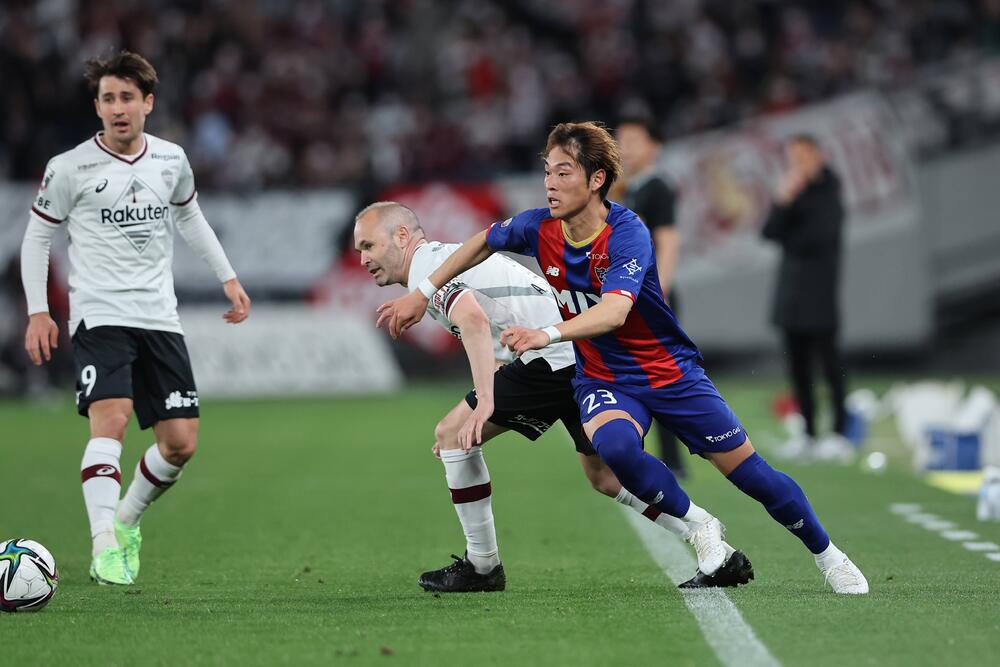
Q: You have been scored against in two consecutive matches, what do you think is the cause of that?
A, I believe that if we can maintain possession of the ball in a better condition, the opponent won't be able to attack. When we are attacked, I think it is caused by poor ball recovery or bad positioning of players during positional play. Of course, I believe the opponent is scouting the fact that I am playing as a side back. When deciding where to target, if it is among the four defenders, it will likely be me, so how I prevent the opponent from doing their work is the most important factor.
Q, after about 21 minutes into the Kobe match, you mentioned that your positioning wasn't very good when receiving the ball from Kimoto. Did you mean that you wanted to take a position a little more inside and face forward?
A, at that stage, I really didn’t want to drop back that far, but when the distance between the player wide and Kimoto was far, I inevitably had to get in between, which meant receiving the ball facing backward. Ideally, in the initial positioning, I would have stayed wide without moving inside, and the wide player would have moved inside. If I could look more broadly—not just at the player in the immediate situation but also at the opponent’s defensive midfielders, forwards, and attacking midfielders—I believe I could have avoided that mistake.
Q, the pass to Nagai after taking Iniesta out in the second goal scene, and the pass to Nagai after passing between Makino's legs in the first goal scene, are all firmly passed to the opponent's feet. Is it more intentional or instinctive to dribble past the opponent?
A: I think the order is that I go for it because I instinctively know I can get past them. Since you can't defend with your whole body, even goalkeepers can be targeted at their feet, and I believe I have statistical evidence within myself that this is a targetable area. That's why I aim for it.
Q, when I took Iniesta out of the scene, I closed my legs well and Iniesta turned his body vertically, so I felt like I caught the opposite feeling, but did you have a sense that it went well at that moment?
A, the defense came at me by pushing my whole body toward the line, so that caught my eye for a moment, and I instinctively switched to nutmeg. The nutmeg also felt like it turned into a backdoor route because the opponent pushed their body in too much.
Q, there was a scene in the early stages of the second half where you pushed the opponent on the right side and shot the ball wide to the right. You were making a move to call for the ball when it came from Nagai's negative, but were you anticipating the ball to come from Nagai's angle and preparing for it?
A, I anticipated and prepared, but I think I was waiting with the wrong foot. I was waiting with my right foot, but I believe Nagai wanted to pass the ball to his left foot, and Nagai himself said he moved forward too much. I realized I need to keep my body neutral so I can pass the ball regardless of which foot it comes to.
Q, I said that if the opponent comes to my place, I will defend it, but I think I have been improving my defensive skills and awareness since the camp. Do you have any advice from the coach or staff on learning defensive techniques?
A, while watching the footage, we discussed how it would be better to do it this way here, and that my defensive style is still that of a midfielder. Including challenges for the ball, I tend to play out of habit right now, so I think I need to consciously work on improving from now on.
Q, the scene where Rui Osako was successfully dribbled past, he went to poke the ball but was countered in return, right?
A, rather than poking at the ball, I tried to crush it, but he skillfully turned in front of me.
Q: I think you have many opportunities to take throw-ins as a side back during the midfield. What is your awareness of throw-ins? I think Albert's tactics also require that approach.
A, I throw the ball so that it comes back to me, and it’s good if I can get the ball returned with one touch. I just make sure not to lose it when I throw it directly sideways.
Q: Where do you feel is the biggest difference and difficulty in defending in midfield and as a fullback?
A, in midfield, when contesting a 50-50 ball or trying to take the opponent's ball, I always defend in a way that ensures I can secure the ball for myself. For example, even when it's unclear who will get the ball in a close contest with the opponent, I try to make the ball spill forward, and even near the sideline, I defend so that the ball doesn't go out of bounds and becomes ours. It's a small detail, but in my case, I try to go for the ball based on my reaction. If I wait to respond after the opponent makes a move and then try to take the ball, as a defender, I have to increase my intensity and go aggressively at the opponent. So, assuming that we will secure the ball, I believe we need to defend with even more intensity, to the point where it's acceptable for the ball to go out. If we can defend like that, I think our defending will evolve into true defending as defenders.
<Keita YAMASHITA>
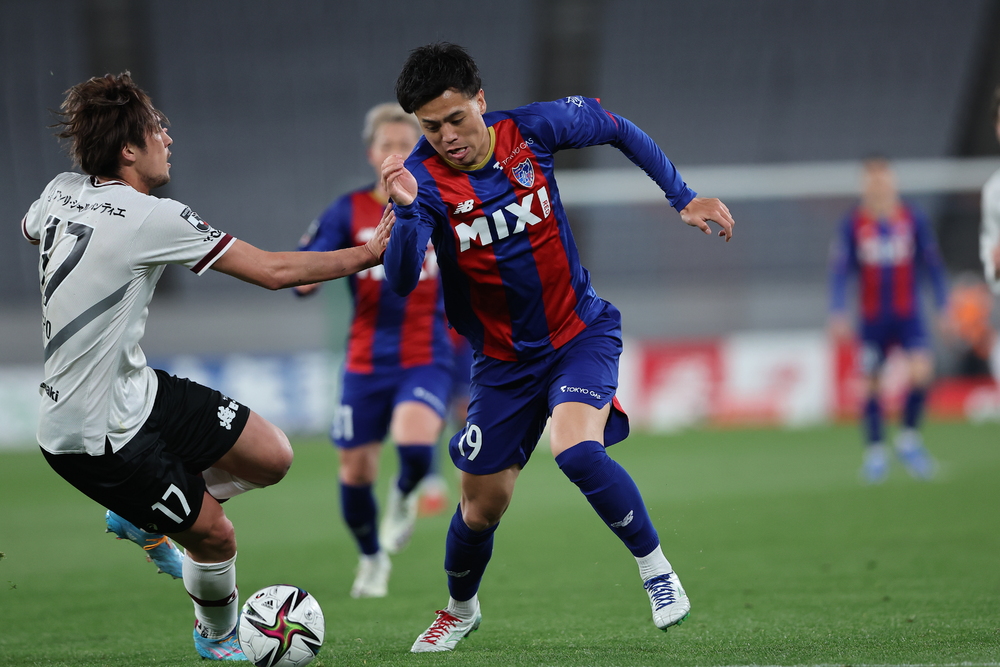
Q: The previous match against Kobe seemed to have been played with a very good feeling. How was it for player Yamashita himself?
A, I think it was my best performance so far. I also had a bit more playing time, but I was able to take shots and had many touches on the ball, so I felt a good rhythm.
Q, it became a phantom goal, but did that celebration explode with emotions?
To be honest, I don't remember much. But since transferring this season, I feel like I've had experiences that I've never had before.There was frustration and impatience from not being able to play in the matches, and I wanted to create an opportunity within myself and break through. It may not have been a flashy goal, but it was a gritty and characteristic play, so I think that's why I made that kind of action.
Q, all my teammates also came running towards me.
A, at that time I didn't understand at all, but when I watched the video again, I was still happy.Little by little, I thought I was being recognized, and I felt once again that I want to score goals and contribute to the strength of this team.
Q, it would be nice if it could be a good opportunity for something.
A, that's exactly right. Although it ended up being a no-goal, for a forward player, shaking the net like that makes a 180-degree difference emotionally. I also feel a sense of progress in a positive direction, so I want to quickly score a real goal at Ajinomoto and work hard to be recognized by the Tokyo fans and supporters.
Q: Urawa is a team that Kazuto YAMASHITA himself has a good compatibility with. Please tell us your enthusiasm.
A, I scored goals in two matches last season, and I personally think I have a good compatibility with them. Since I am playing as a FW, I believe that scoring goals is expected of me, and naturally, I am aiming for that as well. But first, I want to give my all to run for the team’s victory.
<Takuya AOKI>
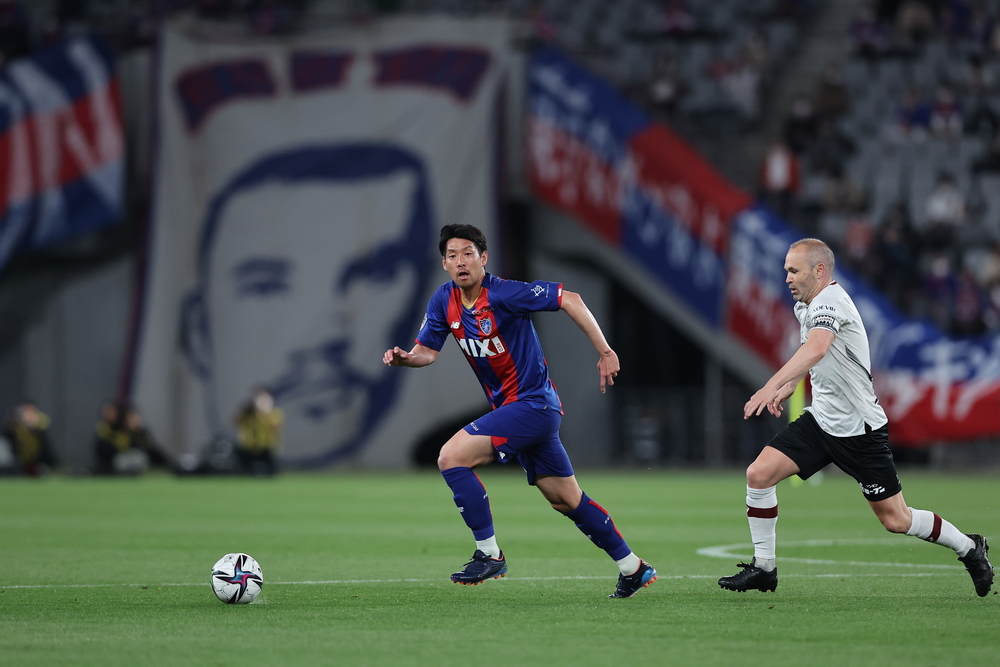
Q, Sec. 7's match against Kobe Univ, winning and having a good start with 4 wins in 6 league matches. Don't you feel confident?
A: We feel confident that if we can play our style of soccer, we can win. The team has been playing well, and even in the matches we lost against Kawasaki and Yokohama FM, I think the content was not bad. However, without the ability to at least secure a draw in such matches, we cannot rank among the top teams. In that sense, I feel there are still many challenges ahead.
Q: Coach Albert Puig Ortoneda says "we are still in the growth stage," but how does player Aoki evaluate the current team?
A, I don't mean that the current situation is unsatisfactory, but rather that we are always working with the word "growth" in mind. There are times in matches when we can express our style of soccer well, and times when we cannot, so our goal is to bring that to 100%. However, it is certain that the players are gaining confidence through consecutive victories and are able to train well with focus.
Q: What kind of play is the coach expecting from you?
A, I think I am expected to maintain the team's balance. I adjust my position so that too much space doesn't open up, and when the rhythm is off, I try to calm the ball down once, being mindful so that the entire team can play smoothly. When the flow of the game is bad, there is a lot of work to do, but so far there have been many good moments, so I can play naturally.
Q, please tell the fans and supporters about your enthusiasm for the Urawa match.
A: Urawa won the Emperor's Cup last season, and I have the impression that they become a better team every time we face them. However, we absolutely cannot lose at our home, Ajinomoto Stadium. Especially this match, there are no restrictions on the number of spectators, so we will be playing in front of a large crowd of fans and supporters, which motivates us even more than usual. We definitely want to win so that everyone can go home feeling good!
OFFICIAL MATCH DAY PROGRAM IS HERE!