

Q: We have qualified for the World Cup, but the Asian final qualifiers had a difficult start.
A: Thrilling situations and matches continued, and at the same time, I found myself simply enjoying those circumstances.
Q: Is it because you have experience? Would it have been different if your younger self had experienced it?
A: If it were my younger self, I probably would have been overwhelmed. However, since this is my fourth time in the Asian final qualifiers, I think having experienced tough battles is significant. The way you perceive that situation is completely different depending on whether you have that experience or not.
Q: Was your experience utilized at the timing of recovering from the first loss?
A: When things are going well, experience isn’t really necessary and you can just leave it be, but when the team is struggling or facing difficult situations, the experience of tough battles really comes into play. I think the reason every coach needs a few veterans is because they help organize the players during those times and bring a positive atmosphere to the team through their experience.
Q: As a player, Nagatomo aims to participate in the World Cup main tournament for the fourth time. Immediately after the end of the Asian final qualifiers, he commented that the J-League matches would become important.
A: That's right. If I don't achieve results in Tokyo, it won't lead to the World Cup stage. That's why, when the Asian final qualifiers ended, I felt even more determined that I must return to Tokyo and perform well in the J-League.
Q, I think that feeling is immediately evident in Nagatomo's play in Tokyo since his return. Although he couldn't participate in the national team's activities and camp, he seems to be quickly adjusting to the team's style while playing matches. How do you feel about the progress?
A: I definitely feel a strong sense of progress. Since I couldn’t join the team’s camp for a month, I started from zero in understanding the tactics the coach demands, the play expected from a fullback, and coordination with the surrounding players. However, I feel that my experience has been beneficial in this regard. Having learned the tactics of many coaches both in the Japan national team and European clubs, and having coordinated with numerous players, I am certain that my experience has shortened the time needed to fit into the tactics.
Q: There may not have been exactly the same tactics in the teams you have belonged to so far, but in the accumulation, are there any elements that can be pulled out and say, "This is the essence of this football" from many inspirations?
A, I have learned under many coaches and have a wide range of options, and both in European teams and the Japan national team, there have been many player rotations. In that environment, every coach chose to use me, which gave me confidence and helped me develop my adaptability.
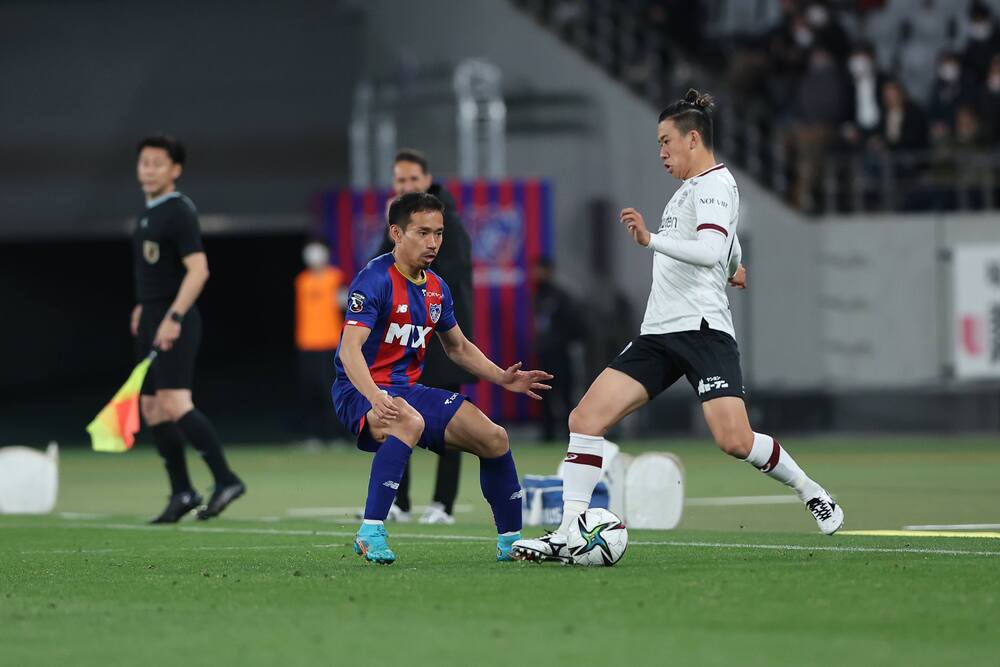
Q, for example, in the recent Vissel Kobe match, there was a scene where I felt Nagatomo's adaptability to tactics. In Diego OLIVEIRA's scoring scene, Nagatomo's position is imagined to be on the outermost side, but he came into the central area and flicked the pass from the midfield to connect it to a goal. Adailton moved to the outermost area and took a position inside, and it seemed that Nagatomo's movement was firmly incorporated into the team's coordination.
A, regarding that scene, I am very conscious of whether I should receive the ball myself or, by observing the situation, let a teammate receive it while I get involved as the third player in the movement. If it were my old self, even if the pass went from Shuto ABE to Keigo HIGASHI, I think I would have stayed in the position where I was initially. But now, at that moment, I realized that I am not the one who should receive the ball. The instant the ball went from Shuto to Keigo, I was instructing Keigo to pass it back to Shuto. If you watch the video, you will see that I passed it to Shuto and moved into the vital zone that the opponent hates the most. Adailton was positioned wide, and I thought there was one less player connecting with Diego, so I went to create that connection, which led to the goal. Although the final flick was a bit off, I think the intention behind my movement, coordination, and connection fit very well.
<The corresponding scene is 5:33>
Q: We have been playing consecutive matches against clubs participating in the AFC Champions League, and in the next round, we will face Urawa Reds with only 3 days of rest. Do you have any image of Urawa's football?
A, I think they play really good football. We also played against them at home last season, and I felt that Coach Rodriguez is an extremely talented person because the tactics are clearly instilled in the team when we faced Urawa.
Q, it also seems like a team that can change its way of fighting flexibly while having a tactical base.
A: Not only focusing on our own style of football, but also thoroughly preparing countermeasures against the opponent and figuring out how to make the best use of ourselves. I felt during the match that they are putting considerable effort into that aspect.
Q: When playing against such opponents, there is also a desired style of football that we want to play. At the same time, flexibility as a team is also required.
A: Tokyo's aim is also to exploit what the opponent dislikes, so if we can work together to neutralize their strengths, I believe it will surely lead to victory.
Q: In Tokyo, there is Nagatomo on one side and Sakai Hiroki on the Urawa side, both national team fullbacks, and their matchup is attracting attention. You wouldn't want to lose when facing Sakai, right?
A, of course! I have played with Marcelo both in the Japan national team and at Marseille. We will be competing at our home ground, so there is pride and a desire not to lose. Last season, he scored a goal against me, and that was frustrating. If we were to match up, I would want to go all out on the pitch..

Q: We usually get along very well, don't we?
A: We get along very well. Our families are close as well. However, as professionals, if we are opponents on the pitch, I must show the determination to never lose.
Q: I'm looking forward to the intense matchup, but in terms of Tokyo's soccer style, I think it will be interesting to see how Nagatomo contributes to the attack by taking a good position and leaving out Sakai.
A: Of course, there may be matchups, but as Tokyo's style, the best thing is to take positioning where you don't have to fight the opponent right in front of you in the first place. That's why, especially when you have the ball, you want to take positions that the opponent dislikes and create situations where you can win without fighting. It's about deciding the outcome by positioning, or rather, taking a position where you don't have to fight the opponent right in front of you, and just by receiving the ball, the contest is decided. That kind of play is what the opponent hates, and I believe that is the way of playing that most leads to Tokyo's victory. While looking forward to the matchup, I am also excited about those tactical aspects.