<Match Preview>
In the previous match, Kazuya KONNO's superb goal helped Fukuoka to a 2-2 draw, stopping their losing streak. However, coach Albert PUIG ORTONEDA expressed his disappointment after the game, saying, "We had the potential to turn the score from 2-1 to 3-1, so it's a shame that we were equalized by a penalty kick. It's an important point, but we wanted to get all three points," showing his frustration.
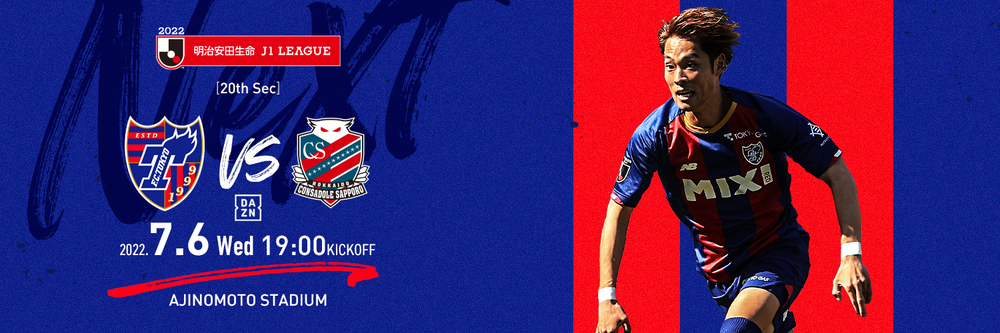
This week, we welcome Sapporo to our home stadium, Ajinomoto, aiming for our first victory in 4 games. With Tokyo in 8th place and Sapporo in 10th, this is a crucial match that we cannot afford to lose if we want to climb up the rankings.
Pedro, who has been in Japan for 17 years, is in charge of Sapporo. As a commander, he has a career of over 500 J1 games and pursues an attacking soccer using a unique variable system. In the previous match in April, both teams showed their strengths but ended in a 0-0 draw. As Tokyo, we want to demonstrate our progress in the past 3 months on the pitch and seize victory with an aggressive attitude that takes advantage of our home field.
Coach Albert Puig Ortoneda said, "The longer we can possess the ball in the summer, the better it will be for us," and it seems that the team's emphasis on "ball possession" will be the key to victory.
Summer night, Tokyo's attacking soccer further heats up Ajinomoto.
[Albert PUIG ORTONEDA Interview]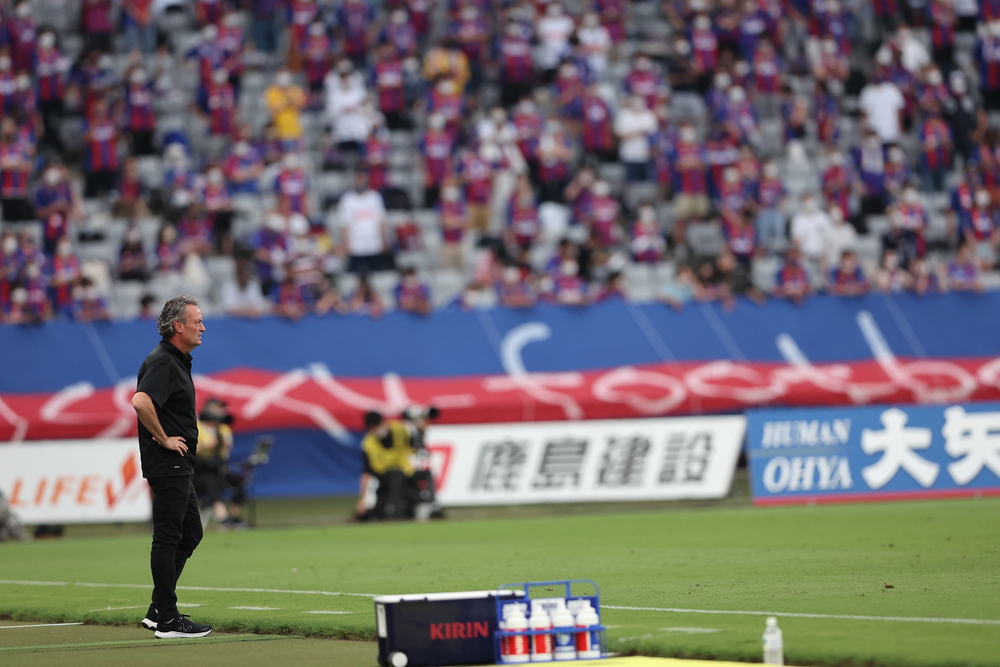
Q: Will there be vocal support at tomorrow's match?
A: Since coming to Japan, I have only experienced one match in two and a half years where vocal cheering was allowed. The last time I played a match with voices echoing was the away game against Gunma in the 2020 season, so I am really looking forward to tomorrow. After all, I believe that the cheers are one of the true pleasures of soccer.
Q, do you think the voices of fans and supporters have a positive impact on the team?
A: First of all, I do not think we are in a bad condition at all. If we were in a bad condition, it would be a critical situation to the extent that almost all the coaches of the teams ranked below us would have been dismissed. Of course, the recent match results have not met expectations. However, I do not believe that we are in a dangerously bad state. Also, I think the voices of support in the stadium are a great source of encouragement for us in any situation. They are an important part of the entertainment.
Q, I think we have been building relationships with fans and supporters on SNS.
One of the great points that I feel in Japan is the warm support of the fans and supporters. It is one of the great points of Japan that this good relationship allows players to perform better. Despite not being able to build a close relationship with everyone in Tokyo, I still feel supported by the fans and supporters, even though I haven't been able to make any noise since the start of the season. I can still feel the love because of that. I think SNS is effective for me because I can deliver messages directly to the fans and supporters.
Q, what is something that has left an impression in your messages?
A, it is not a specific comment, but the fact that many warm comments are left regardless of the team’s situation is what truly surprised me.
Q, why are you using SNS?
A, of course, while understanding that SNS is only a part of real society, in the past I did not have a tool to send messages directly. However, now that it exists, I want to make effective use of it. I believe that when used appropriately, it is a tool that can have a sufficiently effective impact.
And in my experience, I believe it is important to communicate in any situation. For example, if we do not continuously explain how difficult this season will be, many people will simply follow the game results and evaluate based on that short-sighted perspective. In order to prevent this, I hope to deepen the understanding of fans and supporters by properly explaining what is expected this season and the reasons for what may happen.
In summary, I think we have built a great relationship with the fans and supporters in Tokyo from the first day, and I hope this will continue. They are wonderful people.
Q, Aoki player, Abe player, and Nakamura player were not present.
A, Aoki player got injured and is out of the lineup, and it may take a little longer. While properly managing fatigue, he got injured during yesterday's practice. Nakamura player was injured during the Fukuoka match. I think he can return in about 3 to 4 weeks. Abe player is highly likely to join the team next week.
Q: In the midst of injured players, will the strength of young players be necessary?
A, I have high expectations for the players. I also have expectations for Kajiura. I have absolutely no hesitation about giving young players opportunities. However, I ask two things from the players. First, to deliver a solid and good performance. And second, to have a mentality that is committed to winning. Mistakes are allowed. For example, I want to give young players more and more chances. But I believe there is no value in giving chances to players who do not firmly demonstrate these two aspects.
Q, how do you feel about the increase in goals conceded?
A, except for the 5 goals conceded in the away match against Fukuoka and the 5 goals conceded in the away match against Tosu, the numbers are by no means bad, and the number of goals conceded has been kept low. However, I think the large number of goals conceded in those two matches remains memorable. The one goal conceded in the previous Fukuoka match was due to a tactical mistake. The second goal was partly unlucky, as a whistle was blown and it resulted in a penalty kick.
I think there can be a discussion about the number of goals conceded, but on the other hand, I think there can also be a discussion about the fact that there are few goals. It is still impossible to win without scoring points, and even if you concede points, you can still win if you score more goals than that. You can also focus on the number of goals conceded, but I think it is also one way to improve by focusing on the fact that there are not enough goals.
Of course, I think fatigue is also affecting us. And the shortage of center-backs is also causing fatigue. The transfer of Ogawa player is also affecting us. Naturally, we are not yet a perfect team. And just like us, other teams are also fighting for victory, so it is natural that it will be a difficult match. Except for the two games where we conceded a lot of goals against Fukuoka and Tosu, I interpret that our number of goals conceded is sufficiently low.
Q: I think the term "box out" was used before, is it still being used? Or has the defense also changed along with the offense?
A: Indeed, in the recent Fukuoka match, one of the causes of the first goal conceded was that we failed to box out properly in defense. However, we are human, so mistakes do happen. Except for the heavy goals conceded in the Tosu match, the three goals conceded in the Nagasaki match and the first opening goal in the Tosu match were all incredible goals—superb goals that you might see once or never in a lifetime. Still, it is quite possible for us to concede goals when such wonderful goals are scored from limited chances. Of course, we have not changed our defensive shape. However, we are continuously working on reducing mistakes and maintaining proper and appropriate defense. That said, I think the thinning of our player roster is having an impact. Ogawa has left, Henrique has left, Aoki is also out of the lineup, and Abe is injured. Various players have been sidelined for different reasons, but the team must adapt and respond to these situations.
Of course, the game result is naturally determined by the number of goals, but as a coach, I am focusing on the game content while understanding that. I think we played well enough in the first half of the Tosu game, and we also created several decisive chances. The Nagasaki game was the same. We created several chances that we had to score multiple goals in the first 15-20 minutes of the game. That's why there is a discussion about whether it is better to reduce the number of goals conceded or to increase the number of goals scored. Of course, that balance is important, but reducing the number of goals conceded is a key point. However, as a team, we also have to focus on increasing the number of goals.
[Player Interview]
<Keigo HIGASHI>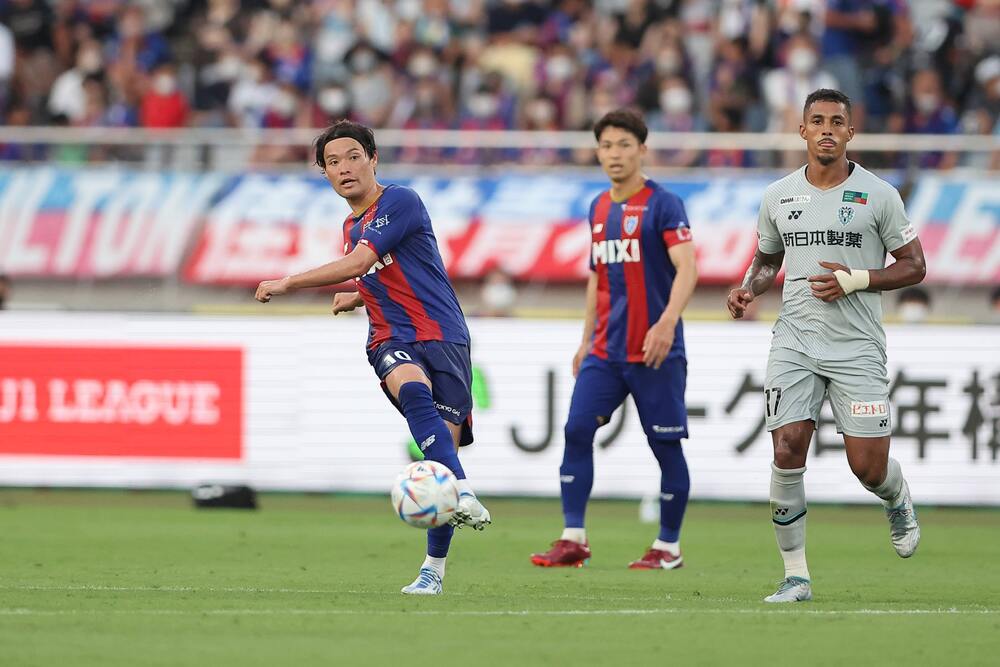
Q: It has been three days since the Fukuoka match in the previous round, what preparations did you make?
A: I took good care of my body and prepared to perform well in the Sapporo match.
Q, what kind of impression do you have of Sapporo.D?
A: Since Misha (Mihailo Petrović) became the coach, Sapporo.D has become more offensive, effectively using the flanks and breaking down defenses with combinations. Defensively, I think they will play man-to-man, so we will be cautious about that while making sure to bring out our strengths.
Q: What kind of play is expected of East player among them?
A: Since the opponent will come to defend from the front line, I think space will open up behind them, so I want to skillfully distribute passes into that space and make the most of our speedy players.
Q, is it important to play patiently even when things don't go well in soccer where it is difficult to hold the ball?
A, that's right. In the Fukuoka match, there were periods when we were able to keep possession of the ball but struggled to create chances. However, since we went into halftime trailing 0-1, the opponents started to stretch out in the second half, and when the game opened up somewhat, we were able to turn things around. Although we were caught up in the end, I think it would have been a difficult match if we had conceded 2 or 3 goals in the first half. In the previous match against Tosu, we lost patience and fell apart, so while there may be times when we are pressed defensively, I want to play patiently in the Sapporo match as well.
Q, in the past few games, we haven't been able to score in the league matches, but we were able to score multiple goals in the Fukuoka match. What do you think the contributing factors are?
A, I think there are various factors, but whether a player can finish when given a chance ultimately depends on their final decision. However, if we increase the number of those chances, I believe we can score goals, and it is important to get to the point where we can take a shot.
Q: How do you feel about the start of vocal support for the Sapporo.D match?
A, there is nothing happier than this. Since it's a home game, and we have been helped and energized by the cheers of the fans and supporters so far, I am really happy to think that we will receive that power again.
Q, please tell us your enthusiasm.
A, the team has not been getting results easily, but I believe a good world awaits once we overcome this period. I want everyone to believe and follow us, and the world is also changing so that vocal support can be done. If we win at home, I think the team's momentum will increase, so I want to play a good match and secure a solid victory.
<Jakub SLOWIK>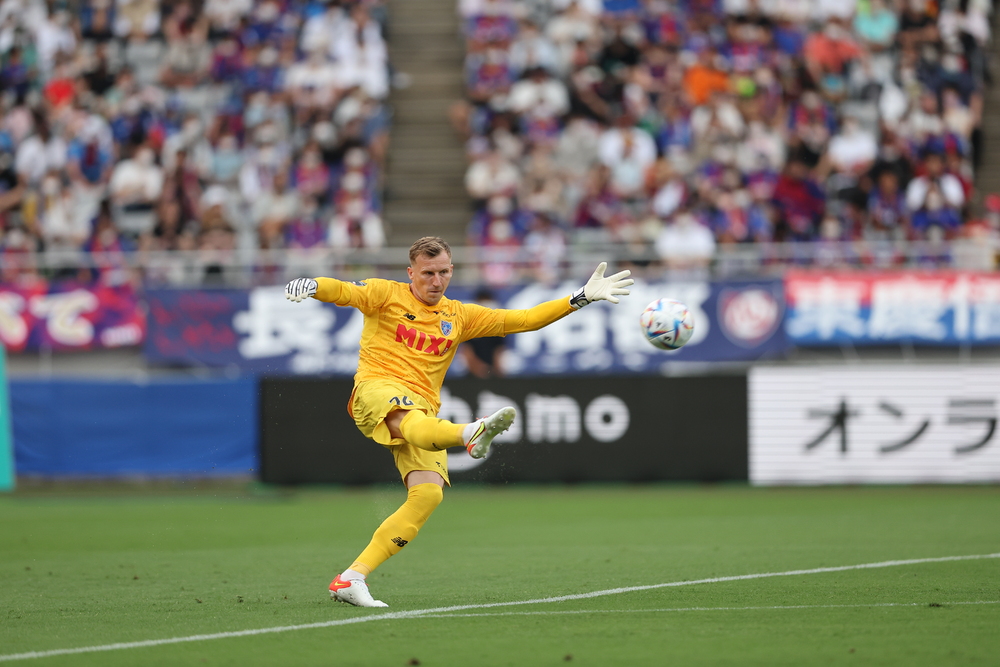
Q, the previous match against Fukuoka ended in a frustrating draw after leading 2-1.
A, considering the situation of consecutive away losses, I think we were able to achieve the minimum result, but of course, we cannot be satisfied with just 1 point. Everyone involved with Tokyo now, including all the players, staff, and fans/supporters, strongly desires victory. I want to express that feeling in this match against Sapporo.
Q, what kind of play is required of goalkeepers in the "ball-loving" soccer that Coach Albert is aiming for?
A, the style of soccer the coach aims for requires technical skills with the feet. I am working on daily training to adapt to this. However, the most important job for a goalkeeper is shot-stopping and firmly protecting the goal. This does not change regardless of the style.
Q, when did Swobik start using Japanese for coaching his teammates?
A, when I came to Japan in 2019, I learned to give at least basic instructions in Japanese. However, what is more important than words is that the players understand each other and defend as an organization. If good communication is maintained during practice, the language used during the match is not much of an issue, I believe.
Q: In this match against Sapporo, a "vocal support area" will be set up in a part of Ajinomoto Stadium. What kind of support do you expect from the fans and supporters?
A, I have played against Tokyo as a Sendai player in the 2019 season before the COVID-19 pandemic, so I know the original atmosphere of Ajinomoto Stadium. I am really looking forward to hearing the wonderful chants and cheers from Tokyo’s fans and supporters. Even when the results are not good, I am always grateful to everyone who warmly supports us. This match, I will do my best so that I can hear your victorious cheers.