Company Name
Tokyo Football Club Co., Ltd.
Established
1 October 1998
Principal Business
1.
Management of Professional Football Team gF.C.Tokyoh Joined J.League Division2 in 1999.
2.
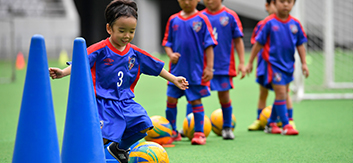
Football School and Popularization of Football.
3.
Production and Sale of team merchandise.
Head Office
Address: 2-15-10 Sarue, Koto-ku, Tokyo 135-0023 Japan
Tel: 03-3635-8985 Fax: 03-3635-8974
Kodaira Ground
Address: 2-584 Onuma-cho Kodaira-shi, Tokyo 187-0001 Japan
Tel: 042-342-8950 Fax: 042-342-8973
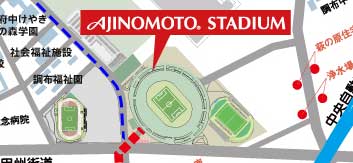
Ajinomoto Stadium Office
Address: 376-3 Nishi-machi, Chofu-shi, Tokyo 182-0032 Japan
Tel: 0424-88-6255 Fax: 0424-88-6253
Capitalization
863,000,000Yen
President
Yutaka MURABAYASHI
Investors
368 Groups ( 342 Companies, 26 Groups )
Club History
| 1935 |
Founded as the Tokyo Gas Football Club. Played in the
Tokyo Metropolitan League. |
| 1986 |
Promoted to the Kanto League Finished Fourth. |
| 1991 |
Won the National Regional League Final Tournament. Promoted
to JSL2. |
| 1992 |
Joined JFL. Maintained a high position. |
| 1997 |
Defeated three J-League teams to reach the quarterfinal
of the Emperor's Cup. |
| 1998 |
JFL Champions, in the final year of the League. |
| 1999 |
Joined J.League Division2 Defeated three J.League teams
to reach the semifinal of the Nabisco Cup. Finished second in the League. Promoted
to J.League Division1. |
| 2000 |
Opened with three consecutive victories to finish 6th
in the 1st stage. Began the 2nd Stage with five consecutive victories to finish
8th, 7th overall, the "Tokyo Sensation", the best performance by a newly promoted
team in J-League history. |
| 2001 |
After finishing 9th in the first stage and 8th in the
second for an overall 8th place in 2001, F.C.TOKYO have firmly established
them selves in J1.
Kiyoshi Okuma, who managed the team for seven years with a motto of "Fight
to the Finish", passed the baton to new manager Hiromi Hara, whose commitment
to attacking football, coupled with the tenacity developed under his predecessor,
begins a new stage for the club. |
| 2002 |
The opening game of the 2002 season produced a thrilling
victory over defending champions Kashima Antlers that saw F.C.TOKYO's " attacking
football " explode into life. However, a series of injuries to key players
meant the club finished the first stage in 10th. place. The second stage witnessed
the rapid development of the younger players and the club posted a best ever
5th. place finish ( 9th. overall ), creating great anticipation for the 2003
season. |
| 2003 |
2003 saw the abolition of extra time in league games and
F.C.TOKYO, under a slogan of '90 minutes of attacking football' had the best
defensive record in the first stage, finishing a club highest fourth in the
table. The good form continued in the second stage as F.C.TOKYO challenged
for the title until the final game, eventually finishing fifth and as top scorers.
The combined ranking saw an overall fourth place finish, the best in club history,
proof of the rapid development over the year.
Prior to the second stage F.C.TOKYO played a friendly against Spain's Real
Madrid before a sold-out crowd at the National Stadium. Although the match
ended in a 0-3 defeat the players gained invaluable experience against the
world's best on the big stage.
Following the season the talismanic 12-year veteran and 'King of Tokyo' Amaral
retired.
One chapter in the club's history finished but 2003 saw F.C.TOKYO moving up
to a higher level. |
| 2004 |
Under a slogan of 'Amazing, Adrenalizing, Attacking football'
F.C.TOKYO began the league campaign with positive intent but the loss of key
players to injury and the Olympic and National teams prevented the side from
fulfilling its potential and resulted in an overall ranking of 8th. ( 6th.
in the First Stage and 10th. in the Second ).
However, the adverse situation unified the team and it advanced to the final
of the Yamazaki Nabisco Cup, winning a dramatic penalty shoot-out against Urawa
Reds for the long-awaited first title. It was a year that saw the club's development
bear fruit. |
| 2005 |
The 2005 league season was changed to a single stage format and F.C.Tokyo challenged for the title under a slogan of, "Amazing, Adrenalizing, Attacking football". The team began the campaign impressively, even reaching the top of the standings, but a series of injuries led to a poor run of form following the 5th. game that saw the side draw one and lose seven out of eight matches and finish the season in 10th. place. Manager Hara left after
4 years at the helm and was replaced for the 2006 season by the club's first non-Japanese manager, Gallo. Inheriting the sound foundations layed by his predecessors Okuma and Hara, Gallo begins a new era for F.C.Tokyo, an era of "Faith, Courage, Challenge". |
| 2006 |
Manager Hara left after 4 years at the helm and was replaced for the 2006 season by the club's first non-Japanese manager, Gallo.
2006With a motto of "Faith, Courage, Challenge", F.C.Tokyo looked to develope a new style. However, in a season split by the World Cup in Germany, the team's fortunes failed to improve and Gallo was dismissed. Former U-18 coach Hisao Kuramata took over from the 18th.game of the season. F.C.Tokyo eventually finished 13th. in the league, the lowest position in the club's history. |
| 2007 |
Hara returned as manager in 2007 and the club made significant additions to the squad,including the signing of Takashi Fukunishi from Jubilo Iwata. Under a slogan of "It's Our Time-Blue Storm, Red Waves"the team was touted as a possible contender for the title before the season began. However, the opening game ended in defeat for the first time in the club's history and the unfavourable results continued. The side posted four consecutive wins in the second half of the season but was unable to improve the league position and finished 12th. |
| 2008 |
2008 Marked F.C.Tokyo's 10th year in the J-League. Under new manager Hiroshi Jofuku and with a slogan of "Moving Football ~ moving the ball, the players and the hearts of the spectators", the team faced the season with a spirit determined to develope further. The first half of the programme saw the side pile up the points and enter the May break in 3rd.place in the league. The restart proved more difficult with the team unable to win and slipping in the standings but a burst of five consecutive victories propelled the side into title contention. The team fought tenaciously throughout, finally finishing in 6th.place. The team also reached the semi-finals of the Emperor's Cup, a first for the club. That match ended in defeat but it was unquestionably a season that saw the team make a solid and steady improvement. |
| 2009 |
Under a slogan of "Moving Football - Touching the hearts of the audience" the club affirmed a strong desire to contend for the title. Unfortunately the opening match was lost and the side suffered a frustrating start to the season as earning points proved difficult. However, Naohiro Ishikawa found a rich vein of goal-scoring form which coincided with an upturn in the side's fortunes and soon the team was back in contention at the top of the table. The side battled to the end to earn an ACL spot and finished the year in 5th. position. In the Nabisco Cup, newcomer Takuji Yonemoto contributed superbly as the side progressed to the final for the first time in five years. The opponents in the final, Kawasaki Frontale, fought ferociously but Tokyo scored steadily and earned the second title in the club's history. At the end of the season two true blue veterans of the Tokyo Gas FC era bade farewell: Ryuji Fujiyama left and Satoru Asari retired. The year saw the curtain rise on a new epoch for the club. |
Club Policy
To attract a wide range of support from all sections of local society.
To be a "J-Club for the People".
To be a "Hometown Club", open to all.
F.C.Tokyo Basic Principles
F.C.Tokyo aims to become a local club for the people by collaborating with local society, administration and business to develop systematically in the long term.
| 1. |
To develop, through football, the physical and mental health of youth and to promote the health of the local population and bring pleasure. To encourage sporting culture and contribute to local growth through international exchange and friendship. |
| 2. |
To embrace, in the near future, sports other than football, in both competitive and recreational forms, and contribute to local society through them. To promote gLifetime Sporth through the base of a J.League club. |
| 3. |
To become a fitting symbol of the capital city that nurtures the dreams of young people. To develop a broad fan base, promote feelings of regional identification and solidarity and be active in the local community. |
| 4. |
To create football schools and clinics and promote football through co-operation and collaboration with schools and local areas through various events. Beginning with young people, to offer guidance and leadership in matters relating to football to all levels of local society. |
Team Colors
Blue, Red.
Team Mascot
Pet name "Tokyo Dorompa"
Born on the 1 st . of October 1998 in Mamiana-cho, Minato Ward Tokyo, midway between Roppongi and Tokyo Tower , making Dorompa a true son of the city. He plays in the fountain found in the lovely Mamiana-cho park. Given his propensity to appear and disappear in the blink of an eye his friends took to calling him Tokyo Dorompa. He also earned the name for inhabiting a nest close to Tokyo Tower . In the Japanese Raccoon Dog world he is universally recognized as a Tokyo fan. An offer to become the official mascot was sent and he is now the team mascot. |
Team Strips
First: Blue, Blue, Blue
Second: White, White, White
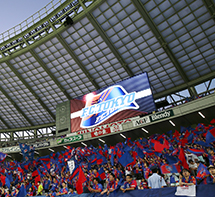
Home Stadium
Ajinomoto Stadium
376-3 Nishi-cho, Chofu City, Tokyo 182-0032 Japan
Capacity
49,970
|